The Best Jeep Wrangler Roof Racks for Soft Tops: Expert Guide to Top-Tested Options 2026

Choosing a roof rack for a soft-top Wrangler requires a different approach than hardtop setups. Soft tops lack rigid mounting points and structural integrity around the roof line, making compatibility a real concern—not just a preference. Adding cargo capacity shouldn’t force you to sacrifice your soft top’s convenience. The best options keep your top accessible while delivering genuine cargo space and durability.
This guide evaluates the top roof racks engineered specifically for soft-top Wranglers, breaking down capabilities, installation requirements, and real-world performance so you can make an informed choice.

What Makes Soft-Top Compatibility Different
Standard roof racks bolt directly to factory hard-top points or roof rails that simply don’t exist on soft-top models. Many racks designed for hardtops physically interfere with the soft-top frame or hide the attachment points needed to raise or lower the top. This creates two problems: either the rack prevents top access entirely, or it damages the top mechanism when you try to use it.
Soft-top-specific racks solve this through tilt-back mounts, removable crossbars, or frame-attached systems that bypass the roof structure altogether. Understanding this distinction separates practical choices from frustrating purchases.
Weight capacity also differs significantly on soft-top vehicles. Most manufacturers recommend limiting dynamic loads (weight while driving) to 150–300 pounds, and static capacity (parked) to 600–700 pounds maximum. Soft top structures simply can’t handle the stress hardtops withstand. Exceeding these limits risks sagging the roof fabric, cracking mounting brackets, and voiding warranties.
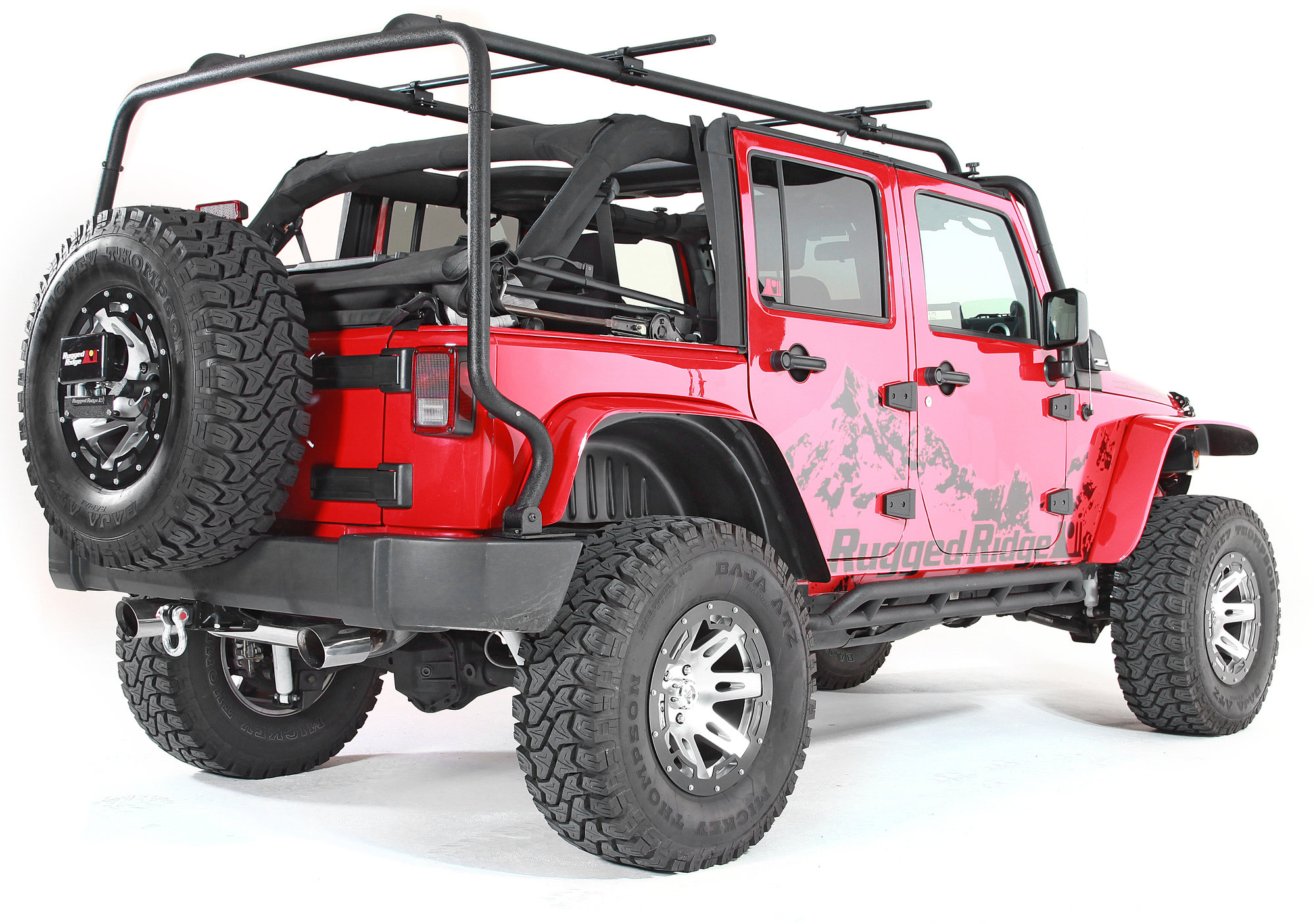
Rugged Ridge Sherpa Roof Rack – Best Overall for Soft Tops
credit: www.quadratec.com
The Rugged Ridge Sherpa (models 11703.02 for JK/TJ, 11703.23 for JL) leads the soft-top market because it solves the core compatibility problem through a clever tilting design. The entire rack pivots backward at the rear frame attachment, allowing you to raise or lower your soft top without removing the rack system—a feature competitors rarely match.
Construction uses 50mm tubular steel with a textured black powder coat, providing genuine durability against corrosion and UV damage. The frame includes integrated light bar mounts at the front, accepting four auxiliary light tabs for spotlights or LED pods. No drilling or cutting required—all fastening happens at existing frame attachment points on Jeep models.
Weight capacity sits at 300 pounds dynamic and up to 600 pounds static, suitable for kayaks, camping gear, and soft luggage. Reddit users consistently note this limitation prevents rooftop tent installations—many modern RTTs weigh 100+ pounds by themselves. If tent camping is your goal, this rack falls short despite its soft-top advantages.
Installation takes roughly two hours for users with basic mechanical skills. The tilt mechanism works smoothly and supports unloaded rack movement by a single person, though many reviewers recommend having a helper given the assembly’s awkward geometry. Rugged Ridge backs the system with a 5-year limited warranty on materials and craftsmanship.
Pros: Tilt-back soft-top access, robust steel construction, integrated light mounts, no drilling
Cons: 300 lb capacity limits RTT viability, heavier than aluminum alternatives, and assembly needs a helper for comfort
Best For: Soft-top owners prioritizing top accessibility with moderate cargo loads
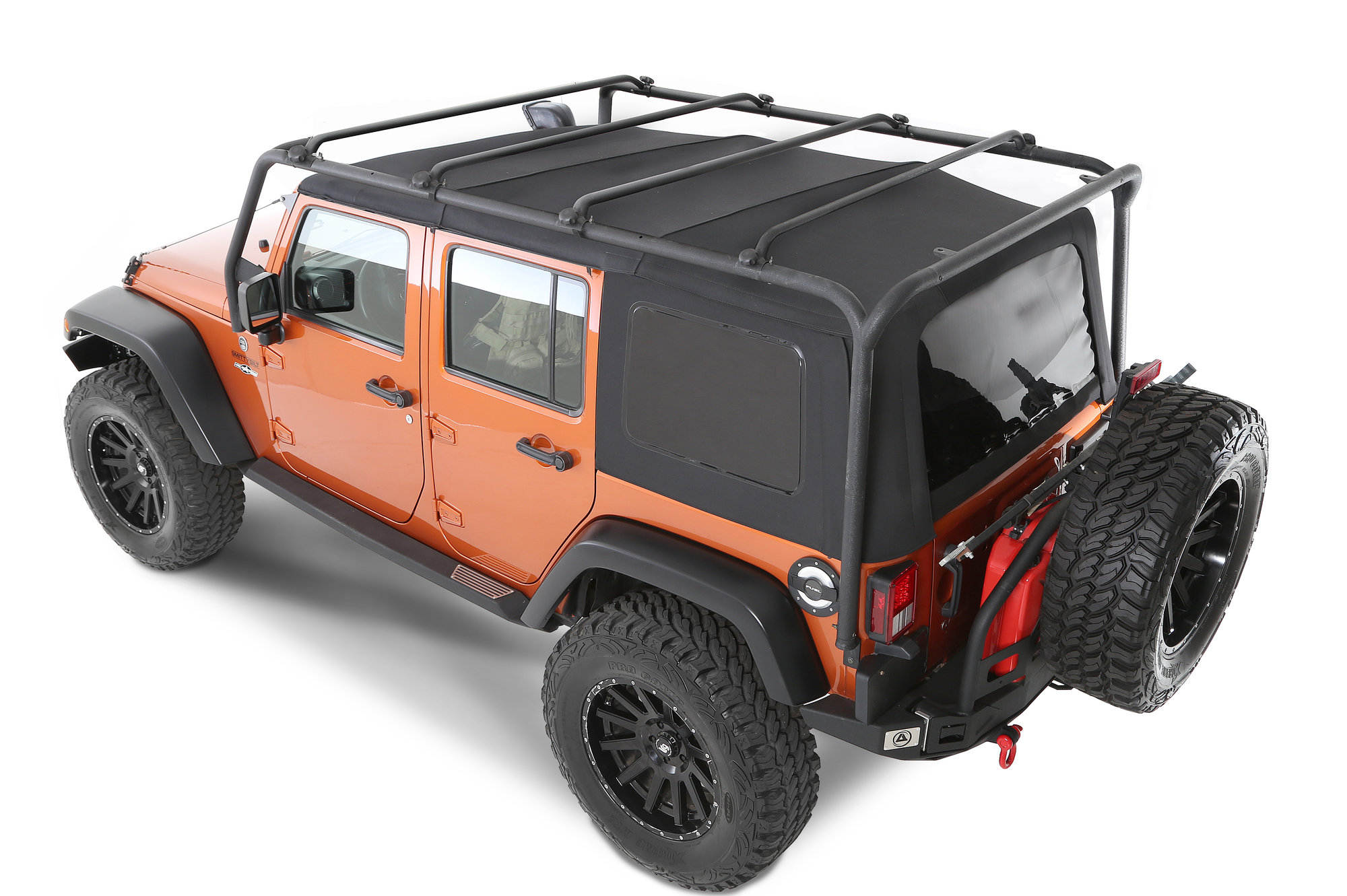
Smittybilt SRC Roof Rack – Best for Sunrider and Power-Top Compatibility
credit: www.quadratec.com
The Smittybilt SRC (model 76717 for JKU, 76713 for TJ) takes a different soft-top approach: removable crossbars. Instead of a permanent frame, you bolt crossbars onto the welded steel side rails whenever you need cargo space. Need your top-up? Remove the crossbars in minutes and set them aside.
This modular design uses heavy 2-inch steel tube construction with 1/4-inch mounting brackets rated for 300 pounds dynamic and 700 pounds static—the highest static capacity in this category. Real-world Sunrider reviews confirm the crossbars clear the mechanism, making this one of the few racks that genuinely works with power-retractable tops without modification.
Installation attaches to the fire frame at the front and frame attachment points at the rear, bypassing the soft-top roof structure entirely. Some users report minimal drilling requirements depending on their Wrangler generation, though most owners with TJ and JKU models handle installation without cutting holes. Smittybilt supplies comprehensive hardware and color-coded brackets to simplify assembly.
YouTube installation videos from owners confirm straightforward mounting in 2–3 hours, though having a helper reduces frustration significantly. The removable crossbar system means you’re carrying less weight on days you’re driving topless, improving fuel economy by an estimated 2–3 miles per gallon versus permanent rack setups.
Compatibility extends to Thule and Yakima accessories, letting you stack bike racks, kayak mounts, or roof boxes on top of the crossbars without proprietary adapters. This flexibility appeals to active owners who swap cargo types seasonally.
Pros: Removable crossbars, Sunrider compatible, highest static capacity (700 lbs), Thule/Yakima compatible, good fuel economy benefits
Cons: Steel weight (heavier than aluminum), requires crossbar removal for top access, and potential drilling on some models
Best For: Power-top owners and active enthusiasts who frequently change cargo loads
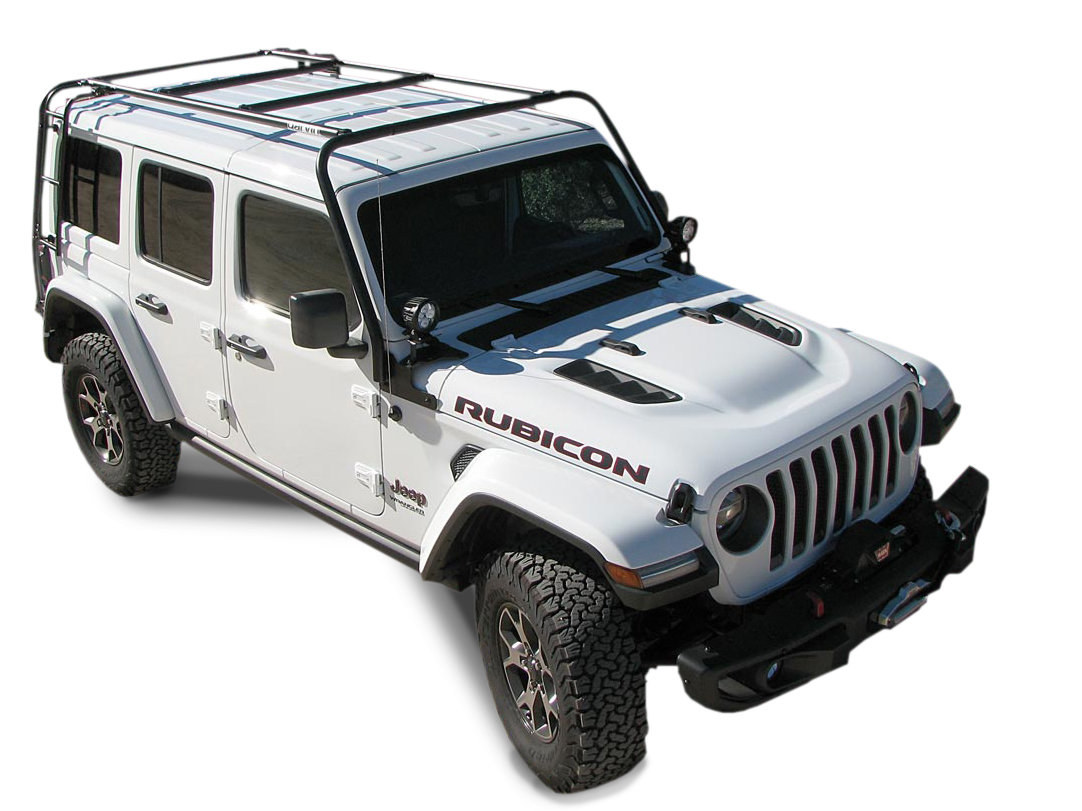
Garvin Adventure Rack – Best Value for Soft Tops
credit: www.quadratec.com
The Garvin Adventure Rack prioritizes simplicity and affordability without sacrificing soft-top functionality. This rack uses a hinged frame that bolts to the A-pillar area and rear frame, tilting backward to provide soft-top access without full removal. Think of it as a lighter-duty alternative to the Sherpa at substantially lower cost.
Steel frame construction uses standard welding techniques, delivering respectable durability despite the budget positioning. Weight capacity maxes at 300 pounds dynamic and up to 600 pounds static, identical to many premium competitors. The hinged mechanism works smoothly and requires minimal maintenance beyond occasional bolt checks after rough driving.
Real users note that top removal timing requires planning—you need to access the rear frame area with the tailgate open and potentially position the tilt mechanism underneath for support. It’s less elegant than the Sherpa’s smooth pivot, but the functional result achieves the same goal.
Installation involves no drilling and typically takes 90 minutes to two hours. The manufacturer ships everything pre-assembled, requiring only bolt-on attachment at frame points. This “less-is-more” engineering keeps the price under $400 for most Wrangler generations, making it approachable for budget-conscious owners.
One practical note from longtime users: you’ll want a socket wrench stored permanently with your Jeep. If unexpected storms demand top installation, you cannot raise the soft-top with the rack tilted back without removing that fastener—a lesson many owners learn the hard way.
Pros: Low cost, hinged soft-top access, no drilling, sufficient capacity for most loads
Cons: Tilt mechanism is less smooth than Sherpa, requires planning for top changes, and needs dedicated socket wrench storage
Best For: Budget-conscious owners and those with predictable seasonal top changes
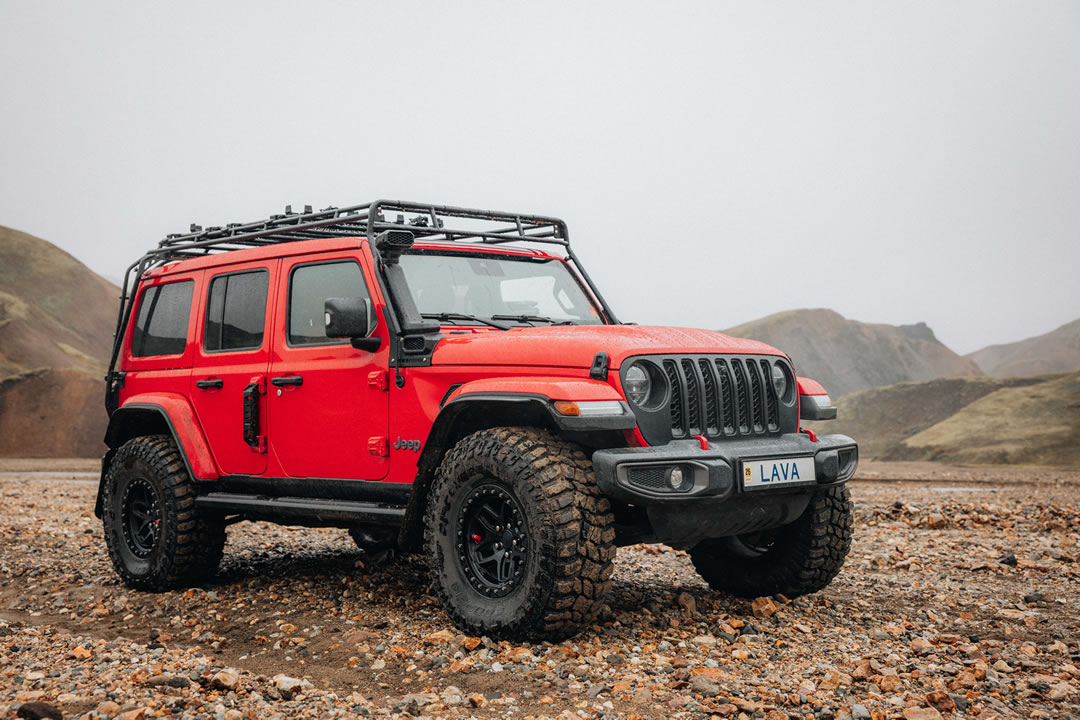
Gobi Ranger Rack for JL – Best for Modern Wranglers
Credit: gobiracks.com
Gobi specializes in modern Wrangler (JL/JLU) racks with no-drilling mounting into original equipment manufacturer anchor points. Their Ranger Rack works with both hardtops and soft tops, accepting power-top systems like Sky One-Touch without modification. This cross-compatibility appeals to owners considering future top upgrades.
The platform uses laser-cut aluminum construction with a traversable mesh floor, balancing strength and weight. Dynamic capacity reaches 300 pounds with an impressive 800-pound static capacity when parked, creating headroom for future rooftop tent upgrades if soft-top days eventually transition to hardtop overlanding.
Gobi’s no-drill system bypasses the soft-top structure entirely by bolting to the vehicle’s frame at specific attachment points. This engineering eliminates the water leak risks associated with roof penetrations. Real owners report clean, dry interiors after heavy rain—a genuine advantage over drilling-required competitors.
The platform measures approximately 50 by 50 inches, offering substantial real estate for oversized cargo. Optional bolt-on ladder mounting lets you safely access roof-mounted gear, though the ladder adds cost. Gobi also offers various lighting configurations, from multi-light setups to minimalist designs, matching different Wrangler aesthetics.
Pricing sits in the premium category at $2,000+, depending on configuration and light options. This investment reflects the modern engineering and American manufacturing standards that Gobi maintains, though competitors offer similar functions at lower price points.
Installation requires no drilling but does demand precision during the bolt-down sequence to ensure even clamp pressure across the vehicle’s roof. Most users complete it in 2–3 hours, though first-time installations benefit from the video walkthroughs Gobi provides.
Pros: Modern JL/JL-specific design, 800 lb static capacity, no drilling, power-top compatible, traversable platform
Cons: Premium pricing, optional ladder costs extra, and less established soft-top community feedback than Sherpa
Best For: 2018+ JL owners and those seeking modern design with future-proof capacity
American Rack Systems (ARS) – Best for Serious Overlanders
credit: metalcloak.com
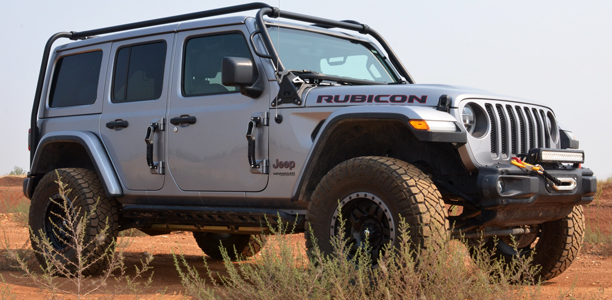
While less mainstream than competitors, American Rack Systems has earned respect among serious overlanding communities and appears frequently on MetalCloak and northridge4x4 retail sites. Their focus on vehicle-specific engineering shows in the frame geometry and attachment methodology.
ARS racks use aluminum construction with aerospace-grade tube profiles, delivering strength-to-weight ratios that beat traditional steel systems. The company manufactures most components domestically, appealing to buyers prioritizing American production. Real users note exceptional precision in welding and bracket fitment—parts go together with minimal gaps or alignment issues.
Soft-top compatibility centers on removable or tilting crossbar systems specific to each vehicle generation. Rather than one-size-fits-all engineering, ARS designs mounting points that consider the unique roof structure and soft-top attachment points for different model years. This attention shows in reliable, quiet operation without the rattling many owners report from heavier systems.
Dynamic weight capacity varies by model but typically ranges from 200–300 pounds with 600–700 pound static limits. Documentation clearly distinguishes between these ratings, a transparency many budget alternatives lack. The company backs products with lifetime structural warranties and detailed load testing data available upon request.
Availability through specialist retailers rather than big-box automotive stores means less visibility and higher search friction. Community research is necessary—read forum threads and watch YouTube installations before committing, as mainstream reviews lag behind the product quality.
Pros: Aerospace-grade aluminum, precise manufacturing, vehicle-specific design, domestic production, lifetime warranty
Cons: Limited retail availability, higher price point, smaller community presence, requires more research
Best For: Overlanders willing to research beyond mainstream and prioritize quality over convenience
Installation and Maintenance Essentials
All soft-top racks require similar installation prep regardless of brand. Start by gathering tools: socket set, wrench set, torque wrench (critical for consistent bolt pressure), silicone sealant, and potentially a drill if your model requires roof penetration. Verify your vehicle’s year and door configuration (2-door vs. 4-door) before ordering—mounting points differ substantially.
Check your Wrangler’s roof load capacity in the owner’s manual. Most stock vehicles support 150–200 pounds of factory roof rail capacity. Your aftermarket rack consumes part of this—a 78-pound Sherpa leaves only 70–120 pounds for cargo on many models. Calculate your actual cargo capacity by subtracting rack weight from the vehicle’s maximum.
Installation timing matters. Choose a level, dry surface and allow 3–4 hours for the first installation, even if the manufacturer’s estimates run 2 hours. Having a helper prevents accidents and frustration, particularly with steel racks and tilting mechanisms that shift unexpectedly if you’re working solo.
Post-installation maintenance includes torque checking after the first 100 miles of driving. Vibration loosens bolts on new installations faster than you’d expect. Tighten fasteners using your torque wrench at specifications provided in manufacturer documentation—over-tightening cracks brackets, and under-tightening invites movement and squeaks.
Seasonal inspection (before and after winter) prevents weather-related failures. Check bolt integrity, verify no rust creeping from fastener areas, and apply touch-up powder coating if chips expose bare metal. Many failures occur not from load exceeding capacity but from neglected corrosion compromising structural integrity.
Soft-Top-Specific Considerations and Trade-Offs
Permanent roof racks change driving dynamics on soft-top vehicles. Wind noise increases substantially—many Reddit users report 6–10 dB increases in cabin noise at highway speeds, reducing comfort on long drives. Aluminum racks generally run quieter than steel due to aerodynamic shaping, though all systems compromise this relative to an unracked vehicle.
Fuel economy penalties typically run 2–4 miles per gallon, though driving style influences this more than rack type. Smooth acceleration and constant-speed highway driving show minimal penalty. Aggressive off-road use, frequent acceleration, and stop-and-go city driving amplify the impact.
Top removal complexity increases with permanent racks. Manual soft tops take 10–15 minutes to raise or lower with practice. Add a rack, and that extends to 20–30 minutes if you need to tilt or remove crossbars first. This reality changes how often owners take tops down—some report essentially leaving them up year-round, despite preferring soft tops specifically for the option to go topless.
Rooftop tent compatibility varies dramatically. Most soft-top racks max at 300 pounds dynamic capacity, but modern RTTs weigh 100–150 pounds and add distributed load stresses. Manufacturers explicitly warn against tent use on many soft-top racks. If overlanding with an RTT is your priority, strongly consider a hardtop upgrade or seek racks rated specifically for tent duty.
Resale value shifts slightly when soft-top vehicles have permanent racks. Some buyers view them as valuable practical additions; others see them as evidence of wear on the roof structure. This is minimal but worth acknowledging if you plan to sell within 3–5 years.
Choosing Your Best Option
Prioritize soft-top accessibility: Rugged Ridge Sherpa or Garvin Adventure Rack wins through tilt-back simplicity and proven soft-top integration.
Want removable crossbars and Sunrider compatibility: Smittybilt SRC delivers modular flexibility and power-top support without compromise.
Own a new JL and want future-proof capacity: Gobi Ranger Rack’s 800-pound static rating and no-drilling design future-proofs RTT options if you transition to a hardtop later.
Demand precision engineering and domestic manufacturing: American Rack Systems rewards research investment with aerospace-grade construction and specialized soft-top design.
Need the lowest investment: Garvin Adventure Rack provides acceptable performance and soft-top functionality at roughly half the cost of premium alternatives.
None of these choices delivers everything—all involve trade-offs between cost, weight capacity, accessibility, and installation complexity. Honest assessment of how you actually use your Jeep—frequency of top changes, typical cargo loads, and whether overlanding with an RTT enters your plans—reveals which compromise best serves your needs.
Soft-top Wranglers and roof racks aren’t inherently incompatible. They just require a smarter selection than hardtop owners face. The right rack balances your need for cargo space against your core reason for choosing a soft top in the first place: the freedom to drive with nothing between you and open sky.