Mini Cooper LS Swap: Complete Guide to V8 Power

The Mini Cooper LS swap transforms a nimble economy car into a tire-shredding powerhouse. Installing a Chevy small-block V8 into a 2,500-pound vehicle creates 400-600 horsepower and an insane power-to-weight ratio. This guide covers costs, parts, fabrication requirements, and whether this extreme modification suits your build goals.

credit: www.motor1.com
What Is a Mini Cooper LS Swap?
A Mini Cooper LS swap replaces the factory engine with a GM LS-series V8. These aluminum-block engines—ranging from 4.8L to 7.0L displacement—deliver massive power while maintaining reasonable weight. Duane Smith installed a 355ci small-block Chevy V8 into his 2003 Mini Cooper S, positioning cylinder heads against the firewall with headers exiting forward through the bumper.
Classic builds push extremes further. One 1977 Austin Mini weighs just 1,500 pounds with a blown 4.8L LS V8 producing 600 horsepower. The radiator mounts underneath the body, and a three-speed automatic sends power rearward. Scott Spencer’s 2004 Mini Cooper R53 prerunner features a 5.3L LS V8 with T56 transmission, custom subframe, 12 inches of front wheel travel, Ford 9.75-inch rear axle, and 33-inch tires.
Why Choose an LS Engine?
LS engines dominate swap projects through exceptional power density and parts availability. Aluminum LS blocks weigh 450-500 pounds—often lighter than stock Mini powertrains when accounting for deleted components. Chevrolet installed LS variants in millions of vehicles from 1997 through the 2010s, creating abundant junkyard inventory and aftermarket support.
Junkyard 5.3L engines cost $600-$800. Used LS3 engines run $2,500. New crate motors start at $7,000. The platform scales from 300 horsepower stock to 1,000+ with forced induction. Forums and YouTube channels document virtually every application, reducing troubleshooting time versus obscure swaps.
Best LS Engine Options
5.3L LM7 and LC9: Budget builders favor these truck engines at $600 from salvage yards. Iron-block LM7s handle turbocharger applications without expensive internals. Aluminum LC9s feature Siamese bores for improved cylinder support. Basic bolt-ons produce 350-400 horsepower—more than enough to overwhelm Mini Cooper traction.
LS1: The original aluminum LS from C5 Corvettes produces 345-350 horsepower stock while weighing 450 pounds. Extensive community knowledge makes troubleshooting straightforward. Compact dimensions suit tight engine bays.
LS3: This 6.2L delivers 430 horsepower naturally aspirated while maintaining aluminum construction. The block handles 850-1,000 horsepower with upgraded studs. Mass aftermarket support includes camshafts, heads, intake manifolds, and stroker kits to 7.0L.
LS7: High-revving 7.0L with factory titanium rods, forged pistons, and dry-sump oiling produces 505 horsepower. This engine costs significantly more but delivers race-ready components for track-focused builds, avoiding forced induction.
Cost Breakdown
Professional Installation
Shops charge $20,000-$30,000 minimum for complete LS swaps. Labor represents the largest expense at $3,500-$5,000 before parts. Import vehicles like Mini Coopers cost more than domestic applications due to complex fitment. No bolt-in kits exist—every mounting point requires custom fabrication.
Suspension reinforcement, brake upgrades, driveshaft fabrication, and fuel system modifications add $5,000-$10,000. Show-quality builds with polished details reach $40,000-$50,000.
DIY Budget Build
Skilled fabricators reduce costs to $7,500-$15,000:
- Junkyard 5.3L engine: $600-$1,200
- 4L80E automatic transmission: $300-$500
- Wiring harness: $130-$600
- Engine mounts and materials: $150-$500
- Headers and exhaust: $500-$1,000
- Radiator and cooling: $200-$500
- Fuel pump and lines: $150-$400
- Driveshaft modification: $300-$600
- Miscellaneous hardware: $500-$1,000
ECU and Tuning
Stock GM ECUs require HP Tuners software ($600-$1,200) plus professional dyno tuning ($500-$1,500). Standalone options like Holley Terminator X ($1,200-$1,800) include plug-and-play harnesses and self-tuning capability for street applications.
Required Parts and Components
Transmission Options
Manual: Tremec T56 six-speed handles 700 horsepower with factory LS bellhousing compatibility. Used units cost $1,500-$2,500; new Magnum variants run $3,500-$5,000. The Magnum offers repositionable shifter locations to clear factory openings. Tremec TKO five-speed provides a budget alternative with 500-600 horsepower capacity. NV4500 offers extreme torque capacity but weighs considerably more. AR5 five-speed handles 350-400 horsepower in lightweight applications.
Automatic: 4L80E provides reliability and affordability, bolting directly to LS blocks while handling 400-500 horsepower stock. Junkyard units cost $300-$500. 6L80 offers better ratios and efficiency but costs more. 8L80 provides ultimate performance with complex controller integration.
Fuel System Upgrades
LS engines require a minimum of 58 PSI fuel pressure with 255 liters per hour flow. Essential components include:
- Fuel pump (Walbro GSS342 minimum: 255 lph/60 psi)
- -6AN fuel lines for stock applications, -8AN for 500+ horsepower
- Fuel pressure regulator for returnless systems
- High-flow fuel filter
- Fuel rail adapters converting push-to-connect to AN standards
Budget $400-$800 for a complete fuel system overhaul.
Wiring Solutions
Three approaches exist:
Stock harness modification: Remove unnecessary wiring while preserving engine management circuits. This budget option costs $0-$200 but requires electrical knowledge. YouTube tutorials demonstrate simplification techniques.
Aftermarket standalone harnesses: PSI Conversion and Speartech offer pre-configured harnesses at $600-$1,500, eliminating wiring complexity with labeled connectors and documentation.
Custom fabrication: Advanced builders create entirely custom harnesses using motorsport-grade components for ultimate control and clean installations.
All approaches require integrating ignition power, grounds, fuel pump control, cooling fans, and diagnostics.
Cooling System
Mini Cooper’s compact bay makes cooling design critical. Multiple builders mount radiators underneath due to hood clearance limitations. This placement works but demands careful airflow and fan attention. Front-mounted radiators require custom fabrication to fit between the engine and the bumper.
High-capacity electric fans replace mechanical belt-driven options. Dual 12-inch electric fans provide sufficient airflow for 400-500 horsepower. Relay-controlled operation prevents battery drain. Budget $200-$800 for radiator, hoses, fans, and coolant.
Major Fabrication Challenges
Engine Positioning and Hood Clearance
Fitting V8 power under a Mini hood demands precise placement. Builders cut transmission tunnels to fit cylinders seven and eight far enough back for hood closure. The LS engine sits with heads against the firewall, forcing exhaust headers forward through the front bumper.
Stephen Brown’s 2004 build required extensive tunnel modifications for his T56. He positioned the engine so the supercharger cleared the windshield without cutting glass. Tall intake manifolds cause hood clearance issues. Truck intakes sit higher than car manifolds and often require hood modifications.
Custom Subframe Fabrication
No bolt-in kits exist. Every installation requires custom subframe fabrication to mount the engine, transmission, and suspension components. Scott Spencer’s prerunner showcases this complexity—he bent tube steel, creating a massive subframe holding the T56, supporting the 5.3L LS, and providing long-travel suspension mounting points.
The LS engine protrudes slightly past the Mini’s short hood, requiring exposed radiator and engine components. Lower subframe tubing wraps underneath, creating a steel bumper guard protecting vital components. Proper design accounts for engine torque, weight distribution, and suspension geometry. Poor welds fail catastrophically. Budget $500-$2,000 for materials alone.
Rear Axle and Driveline
Stock Mini rear ends disintegrate under V8 torque. Builders commonly swap to Ford 8.8-inch or 9.75-inch rear axles for strength, handling 400-600 horsepower reliably. Custom driveshafts connect the LS transmission to the new rear axle. Driveshaft shops cut and balance units to exact lengths with proper universal or CV joints. Expect $300-$600 for professional work.
Rear suspension geometry often requires a complete redesign. Scott Spencer used a triangulated four-link suspension with adjustable chromoly control arms, maintaining proper axle alignment through full travel while handling increased power.
Exhaust Routing
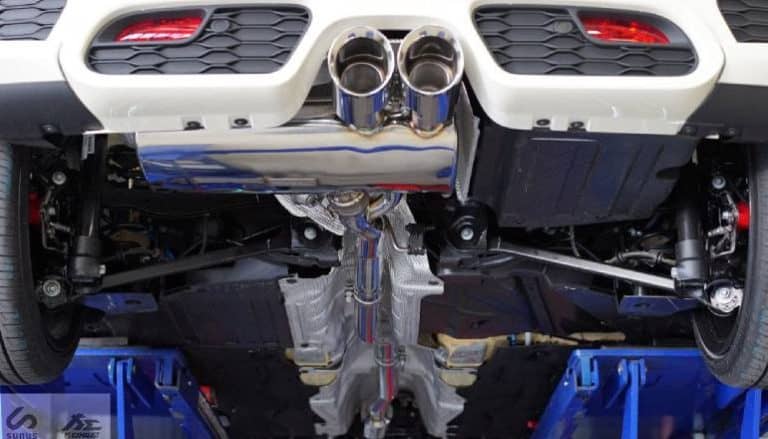
Tight bay space forces creative exhaust solutions. Most swaps route headers forward, exiting through the front bumper. This unconventional approach avoids firewall and floor pan modifications. Custom header fabrication costs $500-$1,500. Stainless steel resists corrosion better than mild steel but costs more.
Dump tubes for turbo wastegates require careful placement away from critical components. Sound levels become extreme without mufflers, potentially causing legal issues in noise-restricted areas.
Performance Gains and Driving Experience
Power-to-Weight Transformation
The stock Mini Cooper S produces 170-200 horsepower in a 2,500-2,800 pound package. Swapping to a 400-horsepower LS doubles output while adding minimal weight. Aluminum LS blocks weigh 450-500 pounds complete, often lighter than deleted stock components.
Results create power-to-weight ratios exceeding supercars. A 2,500-pound Mini with 500 horsepower achieves 5:1 power-to-weight. Porsche 911 GT3 sits around 6:1. Classic 1,500-pound Minis with 600-horsepower LS engines reach absurd 2.5:1 ratios.
Quarter-mile times drop into 11-13 second range for street builds. Drag-focused setups with slicks reach 10-second zone. Burnout competitions showcase tire-shredding capability.
Handling Dynamics
Adding V8 power dramatically alters handling. The LS engine weighs 200-300 pounds more than stock powertrains, shifting weight distribution forward and reducing the Mini’s trademark agility.
Suspension upgrades become mandatory. Upgraded springs, coilovers, and anti-roll bars help manage increased weight and power. Brake system upgrades prevent dangerous fade—stock brakes overheat rapidly when slowing V8-powered cars from triple-digit speeds. Despite compromised handling, drivers report thrilling experiences. Compact dimensions combined with massive torque create unique dynamics.
Reliability Considerations
LS engines deliver exceptional reliability when properly maintained, routinely exceeding 200,000 miles. Swap reliability depends entirely on installation quality.
Common issues stem from poor fabrication:
- Inadequate cooling: Undersized radiators or insufficient airflow cause overheating
- Electrical problems: Loose connections or poor routing create intermittent issues
- Fuel starvation: Undersized fuel pumps lean out mixtures, causing detonation
- Insufficient mounting: Weak mounts or subframe welds fail under torque
Expect initial break-in issues during the first week. Minor leaks, electrical gremlins, and adjustments are normal. Long-term reliability requires proper oil changes (every 5,000 miles), cooling system maintenance, and periodic weld inspections.
Legal and Emissions Considerations
California CARB Requirements
California enforces strictest regulations. CARB mandates:
- Engine must be CARB-certified or have Executive Order
- Engine must be same year or newer than chassis
- All emissions equipment from donor must be installed and functional
- Vehicle must pass referee inspection verifying compliance
- OBD-II systems must remain operational
Only CARB-certified LS engines legally swap into California vehicles. Truck engines typically cannot legally swap into passenger cars due to vehicle class restrictions. Violation penalties include fines, failed inspections, and potential impoundment.
Other States’ Regulations
Most states apply less restrictive rules. Many require only that swapped engines meet emissions standards for the engine’s model year. Some states with antique vehicle exemptions (typically 25+ years) have no emissions testing.
Common requirements include functional catalytic converters (minimum 200-cell high-flow units), evaporative emissions systems, and OBD-II compatibility for 1996-newer vehicles. Research your state’s specific regulations before beginning.
Is a Mini Cooper LS Swap Right for You?
When It Makes Sense
This swap suits builders seeking ultimate power who possess fabrication skills and substantial budgets. The project makes sense if you:
- Own welding equipment and metal fabrication experience
- Have $10,000-$30,000 budget
- Desire unique builds turning heads at shows
- Accept compromised practicality for maximum performance
- Enjoy troubleshooting and ongoing modifications
Existing Mini owners with failing engines sometimes choose LS swaps over expensive factory replacements. A blown N14 engine costs $5,000-$8,000 to replace with another problematic N14. Spending similar money on LS swap provides exponentially more power and reliability.
When to Consider Alternatives
The swap doesn’t suit everyone. Consider simpler modifications if you lack welding experience, need reliable daily transportation, live in California or strict-emissions states, want to preserve nimble handling, or prefer bolt-on modifications.
Stock Mini Cooper S models respond well to performance upgrades without extreme swaps. Learn how to make a Mini Cooper faster with bolt-on parts like a 19% supercharger pulley, intake, and exhaust delivering 200-220 horsepower for $2,000-$5,000. For serious, naturally aspirated power, explore Mini Cooper S upgrades to 300 horsepower through comprehensive modifications. Consider installing best cold air intakes for Mini Cooper S paired with best Mini Cooper S exhausts for immediate gains. Upgrading to an N18 engine from later models provides better reliability than risky N14 motors.
The K-series Honda swap offers another alternative. K20 and K24 engines deliver 250-300 horsepower with bolt-ons while maintaining better weight distribution than LS swaps. Check out the Mini Cooper R56 engine swap kit options for alternative powerplants.
Maintenance and Long-Term Ownership
Routine Maintenance
LS-swapped Minis demand more attention than stock vehicles. Oil changes every 3,000-5,000 miles prevent bearing wear. High-performance applications benefit from full synthetic oils. Cooling system maintenance includes checking coolant levels weekly and flushing annually. Inspect hoses and connections for leaks, especially at custom junctions.
Fuel system filters need replacement every 10,000 miles. Monitor fuel pressure with a mechanical gauge during initial break-in. Transmission fluid changes every 30,000-50,000 miles for automatics, 50,000-70,000 for manuals extend drivetrain life. Differential fluid changes at similar intervals prevent rear axle failures.
Common Issues and Solutions
Overheating: Install larger radiators, improve airflow ducting, or add auxiliary fans. Monitor coolant temperatures with aftermarket gauges.
Electrical gremlins: Secure all wiring away from hot exhaust using heat-resistant sleeves. Use proper crimp connections and heat shrink. Install fuse protection for added circuits.
Exhaust leaks: High-quality gaskets and V-band clamps seal better. Retorque header bolts after initial heat cycles.
Driveline vibrations: Have driveshafts professionally balanced. Check the universal joint condition and replace worn components immediately.
Don’t forget essential maintenance items—use best oil for Mini Cooper recommendations and install best brake pads for Mini Coopers to handle increased stopping demands.
Final Thoughts
The Mini Cooper LS swap pushes engineering boundaries, combining British compact design with American V8 muscle. While challenging and expensive, successful builds deliver unforgettable driving experiences. Research thoroughly, budget realistically, and prepare for long-term projects requiring patience and problem-solving skills. The reward—a 500-horsepower pocket rocket—makes the effort worthwhile for dedicated enthusiasts.