How to Get Jeep Compass Out of Limp Mode: 5 DIY Steps to Fix It

Your Jeep Compass just locked itself to 20 mph, the check engine light is blazing, and you’re stuck in the slow lane wondering what went wrong. Limp mode is the vehicle’s self-protection response — the Powertrain Control Module (PCM) cuts engine power to prevent serious damage when it detects a critical fault.
You can often exit limp mode by disconnecting the battery for 15–30 minutes, checking your fluids, or scanning for diagnostic trouble codes (DTCs) with an OBD2 scanner — but persistent issues require a mechanic.
This guide walks you through every step, from the fastest DIY fix to knowing exactly when you need professional help.
What Is Limp Mode in a Jeep Compass?
Limp mode is a safety default. The PCM detects a fault — transmission, throttle, or sensor — and restricts the engine to protect itself.
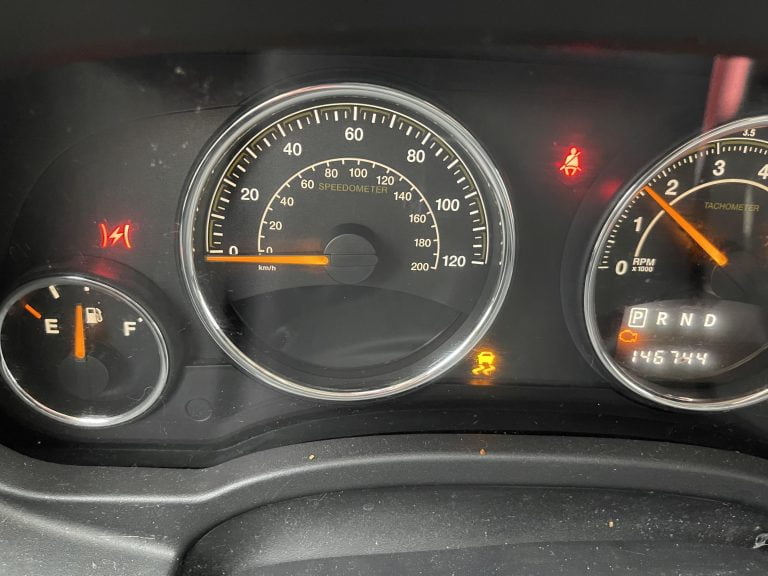
Speed typically drops below 25 mph. You’ll see a check engine light, or the “lightning bolt” icon that signals an electronic throttle control fault. Some owners also notice rough idling, delayed gear shifts, or complete loss of acceleration above a low RPM ceiling.
Think of it like the jeep wrangler towing capacity ceiling — your Jeep has hard limits, and limp mode is the vehicle enforcing its own survival instinct.
The good news: limp mode is often temporary. Fix the root cause, and it clears. The challenge is pinpointing that root cause fast.
Step 1: Perform a Hard Reset (Battery Disconnect)
This is your first move. Always.
Turn off the vehicle completely and wait two minutes before touching anything. Then disconnect the negative battery terminal — the black cable — using a 10mm wrench. Leave it disconnected for 15 to 30 minutes. This forces the PCM to reboot and clears any temporary fault logic stored in memory.
Watch a video guide on resetting limp mode if you want a visual walkthrough of this process before you start.
Reconnect the negative terminal first, tighten it firmly, then start the engine. Drive slowly for 5–10 minutes to allow the PCM to relearn baseline sensor readings.
Common mistake: Reconnecting the battery after only 2–3 minutes. The PCM needs a full power-down cycle to clear stored fault codes. Rushing it means the error logic stays active and limp mode returns immediately.
Second common mistake: Touching the positive terminal first. That risks a short circuit. Always disconnect negative first, reconnect negative last.
If the vehicle starts normally with no warning lights, you’ve cleared a temporary communication fault. If limp mode returns within a few miles, move to the next step — the fault has a hardware or software source that a reset alone can’t fix.
Step 2: Check Oil and Transmission Fluids
Low fluid levels trigger sensor errors. That’s a direct path to limp mode.
Pull the oil dipstick with the engine cold. The oil level should sit between the two marks. Low oil, or oil that looks dark and gritty, can cause pressure sensor faults that mimic serious engine failures. For 2.4L turbo diesel models, use only MOPAR-certified oil filters — incorrect filters can prevent the MAF sensor from reinitializing correctly after an oil change.
Check your best jeep wrangler oil filter options to understand why filter quality matters for engine sensor accuracy.
Transmission fluid is equally critical. Pull the trans dipstick (if your model has one) or check via the fill port. Fresh transmission fluid is pink or light red. Dark brown or burnt-smelling fluid signals heat damage or contamination — both trigger transmission protection faults that lock the Compass into limp mode.
Common mistake: Topping off transmission fluid without checking for leaks. If the level is low, fluid is escaping somewhere. Adding fluid masks the problem without fixing the source.
Use only the fluid type specified in your owner’s manual. ATF+4 is standard for most Jeep Compass automatic transmissions. Mixing fluid types damages the valve body and creates exactly the kind of fault that triggers limp mode.
Step 3: Scan for Diagnostic Trouble Codes (DTCs)
A battery reset clears temporary codes. A scan tells you what’s actually broken.
Connect an OBD2 scanner to the diagnostic port under the driver’s side dashboard. Turn the ignition to the “on” position without starting the engine. Read all stored and pending codes. If you’re new to this process, follow this guide on how to use an OBD2 scanner to read codes before your first scan.
The specific codes you find dictate your next action entirely. Don’t skip this step.
Most common Jeep Compass DTCs related to limp mode:
- P2122 — Accelerator pedal position sensor low input; common in 2018 models
- P279 / P2074 / P2073 — PCM or transmission software fault; affects 2011–2014 2.2L I4 engines
- P0400 — Exhaust gas recirculation flow fault; check MAF sensor and air filter
- C-Bus codes — Communication errors between modules; usually trace back to battery voltage or bad cables
Critical mistake: Clearing the codes without fixing the underlying fault. The codes return within one drive cycle, and now you’ve lost the freeze frame data that shows exactly when the fault occurred.
Write down every code before clearing anything. That data is your diagnostic roadmap.
Step 4: Check the Electronic Throttle Control and Battery Voltage
The “lightning bolt” warning light means one thing: electronic throttle trouble.
Jeep Compass models use a drive-by-wire throttle system — there’s no physical cable between your foot and the throttle body. Instead, the throttle position sensor (TPS) and accelerator pedal position sensor communicate electronically. When either sensor fails or sends an out-of-range signal, the PCM defaults to limp mode instantly.
See this Reddit discussion on 2018 pedal sensor failure for real-world examples of how P2122 presents in daily driving — owners describe sudden power loss, the lightning bolt light appearing at highway speed, and the vehicle refusing to accelerate above 15 mph.
Read the expert explanation of the lightning bolt warning light to confirm whether your symptom pattern matches an ETC fault before replacing parts.
Battery voltage is equally critical here. Low voltage causes C-Bus communication errors — the modules can’t talk to each other, so the PCM triggers limp mode as a precaution. Test with a multimeter at the battery terminals: a healthy battery reads 12.6V with the engine off and 13.7–14.7V with the engine running (alternator charging).
2018 Jeep Compass models with under 30,000 miles frequently showed premature battery failure. If you’re seeing C-Bus codes alongside the lightning bolt light, replace the battery before chasing throttle sensor parts. Learning how to replace a jeep starter covers related electrical system work if your alternator also needs attention.
Note on wheel speed sensors: The Jeep Compass requires at least 3 of 4 wheel speed sensors to function normally. A failed wheel speed sensor can trigger limp mode without any throttle-related codes. Check all four sensors if your codes point to ABS or traction control faults.
After replacing a throttle position sensor, the TPS needs a relearning procedure — you can’t just swap the part and drive. Follow the reset sequence in your service manual, or use a dealer-level scan tool to force the relearn.
Step 5: When to Seek a Professional Mechanic
Some fixes need dealer tools. Know when to stop DIYing.
If your scanner returns codes P279, P2074, or P2073 on a 2011–2014 Jeep Compass with the 2.2L I4 engine, a PCM reflash is mandatory. This isn’t something an aftermarket scanner can fix. The dealer uses wiTECH software at version 14.01 or higher to reprogram the PCM with corrected transmission control logic. Read the official TSBS bulletin for PCM reflash to understand the exact software version and eligibility requirements for your VIN.
Attempting to drive long distances with P279 active risks serious transmission damage. Get it reflashed first.
For 2018 and newer models with persistent P2122, the entire accelerator pedal assembly typically needs replacement — not just the sensor. The pedal assembly costs $80–$150 in parts, and most shops charge 1–2 hours of labor.
If you’ve already handled tasks like how to take jeep wrangler doors off and similar DIY jobs, you know where the line is between home-friendly and shop-required work. PCM reflashing sits firmly in the shop-required column.
For owners of brand-new models, when does the 2026 jeep wrangler come out also covers updated powertrain electronics — worth reading if you’re deciding whether to repair or upgrade.
Decision guide — DIY vs. professional:
| Situation | DIY Fix | Go to Mechanic |
|---|---|---|
| Limp mode cleared after battery reset | ✅ Monitor for recurrence | — |
| P2122 on 2018+ model | ✅ Test pedal assembly | If reset fails |
| P279/P2074 on 2011–2014 2.2L | ❌ | PCM reflash required |
| C-Bus code + lightning bolt light | ✅ Test battery voltage | If battery is fine |
| Burnt transmission fluid | ❌ | Full trans service needed |
Common Jeep Compass Limp Mode Error Codes Explained
| Code | Meaning | Likely Fix |
|---|---|---|
| P2122 | Accelerator pedal sensor low signal | Replace pedal assembly (2018+ models) |
| P279 | Transmission torque reduction fault | PCM reflash via wiTECH 14.01+ (dealer) |
| P2074 | Transmission software fault | PCM reflash via wiTECH 14.01+ (dealer) |
| P2073 | Throttle/pedal range fault | PCM reflash or pedal sensor replacement |
| P0400 | EGR flow malfunction | Check MAF sensor; replace air filter |
| C-Bus | Module communication failure | Test battery voltage; check ground cables |
Codes P279 and P2074 appear almost exclusively in 2011–2014 models with the 2.2L diesel engine. P2122 targets 2018 models. C-Bus errors can hit any year if battery voltage drops below 11.8V.
Pro Tips for Preventing Limp Mode
Staying out of limp mode is easier than getting out of it.
- Test battery voltage every 2 years — don’t wait for symptoms
- Change transmission fluid every 30,000–45,000 miles — Jeep recommends ATF+4
- Clear dust from the throttle body annually — carbon buildup causes TPS errors
- Never ignore a pending DTC — pending codes precede active limp mode events
- Keep an OBD2 scanner in the car — catch faults before they escalate
FAQ: Jeep Compass Limp Mode
Can I drive my Jeep Compass in limp mode?
Short distances only, at low speed. Limp mode caps speed at around 20–25 mph and limits RPM. Driving extended distances risks overheating the transmission or causing secondary engine damage. Get off the road safely and diagnose before continuing.
How long does a battery reset take to fix limp mode?
The disconnect itself takes 15–30 minutes. Add 5–10 minutes of easy driving afterward so the PCM can relearn sensor baselines. Total time: under an hour. If limp mode returns within 10 miles, the fault is hardware-based and needs a code scan.
Is limp mode permanent?
No. Limp mode is temporary if you fix the root cause. It only feels permanent when the underlying fault — a failed sensor, low fluid, or software bug — goes unresolved. Fix the fault, clear the code, and limp mode won’t return.
Will a new battery fix limp mode?
Yes — if the root cause is low voltage or C-Bus communication errors. A weak battery causing voltage drops below 12V is enough to trigger PCM errors. Replace both the battery and test the alternator output if you’re seeing C-Bus codes alongside the lightning bolt warning.
Does the PCM reflash fix limp mode permanently on 2011–2014 models?
Yes. The reflash updates the transmission control software to eliminate the specific fault patterns that trigger P279 and P2074. Once the dealer completes the procedure with wiTECH 14.01+, those codes should not recur unless there’s a new hardware failure.
Conclusion
Getting your Jeep Compass out of limp mode follows a clear sequence. Start with the battery disconnect, check your fluids, scan for codes, and test battery voltage and throttle function. For most owners, one of these four steps resolves the problem. If you’re on a 2011–2014 model with codes P279 or P2074, skip straight to the dealer for a PCM reflash — it’s the only permanent fix.
For most drivers dealing with a one-time limp mode event, the battery reset works. For recurring issues, the code scan tells you exactly what part to target. Don’t guess — the OBD2 data removes the uncertainty and saves you money on parts you don’t need.