How to Do a 5-Tire Rotation on a Jeep: The Complete N-Pattern Guide

A 5-tire rotation moves your matching spare into the regular wheel positions so all five tires wear evenly. It’s the smartest maintenance move a Jeep owner can make. Do it every 3,000–5,000 miles and you’ll dramatically extend the life of expensive off-road rubber.
The key to this procedure is the N-pattern — a specific movement sequence that ensures each tire visits every position over time. Skip the pattern and you’re just shuffling tires randomly. This guide covers the exact steps, model-specific torque specs, and common mistakes to avoid for Wrangler JK, JL, and Gladiator JT owners.
Why Rotate 5 Tires on a Jeep?
Front tires steer and brake. That’s extra stress.
On a Jeep’s 4-wheel drive system, all four wheels share drivetrain load during off-road use. But front tires still wear faster than rears — especially during on-road driving, braking, and cornering. Uneven wear wastes money fast, since how much are Jeep Wrangler tires is a question most owners already know the painful answer to.
Including the spare in rotation means each tire travels roughly 20% of total miles instead of 25%. That single change can add 10,000–15,000 miles to tire lifespan. If you’re running the best all terrain tires for Jeep — which often cost $200–$350 per tire — that’s serious savings.
Pair rotation with best Jeep Wrangler oil filter changes on the same schedule, and you turn two maintenance tasks into one efficient visit. Towing frequently also accelerates rear tire wear, so check the Jeep Wrangler towing capacity chart for your setup and adjust your rotation frequency accordingly.
Critical rule: Only rotate if your spare is a matching full-size tire. A temporary spare never enters the rotation.
Tools and Safety Preparations
You need the right gear before touching a lug nut.
Essential tools:
- Torque wrench (0–150 ft-lbs range)
- Floor jack rated for your Jeep’s weight (3,500 lbs minimum)
- Four jack stands rated at 2+ tons each
- Breaker bar or impact gun
- Wheel chocks (minimum two)
- Gloves and safety glasses
Safety isn’t optional here. Never work under a Jeep supported only by a floor jack. The jack can slip, shift, or fail — jack stands are what keep the vehicle off your body.
Park on a flat, paved surface. Engage the parking brake. Place wheel chocks behind the rear tires before you lift the front — and chock the front before lifting the rear. Like how to take Jeep Wrangler doors off, this job rewards preparation. Similarly, if you’ve tackled something like how to replace a Jeep starter, you already know that rushing setup causes problems that dwarf the original task.
Put the transmission in Park. On manual transmissions, use first gear and chock all four wheels.
The 5-Tire Rotation Pattern (The N-Pattern)
This is the part most guides rush through. Don’t.
The N-pattern gets its name from the visual path the tires trace — it looks like the letter “N” when you diagram it. Watch the 5 Tire Rotation on a Jeep tutorial for a visual reference, then use the diagram below as your working reference while you’re on the ground.
N-Pattern Movement — Visual Diagram:
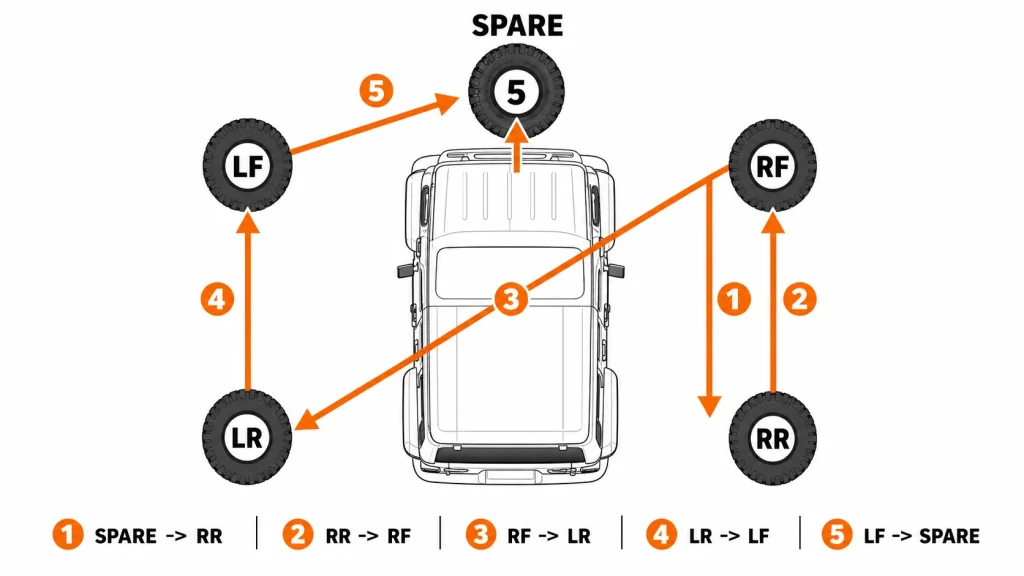
The five moves, in order:
| Move | From | To |
|---|---|---|
| 1 | Spare | Right Rear (Passenger) |
| 2 | Right Rear | Right Front (Passenger) |
| 3 | Right Front | Left Rear (Driver) |
| 4 | Left Rear | Left Front (Driver) |
| 5 | Left Front | Spare Position |
Start with the spare. Always.
Moving the spare to the right rear first frees up a work position, so you’re never stuck holding a wheel with nowhere to put it. This sequence creates the diagonal cross-movement that distributes wear evenly across all five tires over multiple rotations.
Step-by-Step: How to Remove the Spare and Rotate Tires
For a full video walkthrough of the JK and JL spare removal process, the Jeep Wrangler | How To Rotate Tires guide from Morris 4×4 covers the carrier specifics well.
Step 1: Remove the Spare Tire
JL Wrangler and JT Gladiator: The spare mounts on a bolt-on carrier attached to the tailgate. Use a 21mm socket to remove the large center nut holding the spare. Lift the tire off and lean it safely against the vehicle.
JK Wrangler: The carrier swings out with the tailgate. Remove the center bolt with a 21mm socket. Some JK owners find the carrier stiff — spray the hinge with penetrating oil before your first rotation if it hasn’t been opened in a while.
Never use an impact gun on the spare carrier nut at full torque. You’ll strip the threads.
Step 2: Loosen All Lug Nuts Before Jacking
This step trips up beginners every time. Loosen — don’t remove — all lug nuts on all four wheels while the tires are still on the ground. Breaking torque with the vehicle on the ground prevents wheels from spinning freely and protects your wheel studs.
Use a breaker bar with a 21mm socket. One full turn counterclockwise on each nut is enough.
Step 3: Jack Up the Vehicle and Place Jack Stands
Lift the rear axle first using a hydraulic floor jack under the differential or the axle tube. Raise it until there’s 6–8 inches of clearance. Place jack stands under the frame rails or axle at designated lift points — check your owner’s manual for exact locations.
Repeat for the front. The vehicle should now rest on four jack stands with all tires off the ground.
Step 4: Swap Tires Following the N-Pattern
Execute the five moves in sequence. Start by rolling the spare to the right rear position and mounting it loosely. Then remove the right rear, roll it to the right front, and continue through the pattern. Finish by mounting the left front tire onto the spare carrier.
Keep each tire’s position labeled with chalk or tape until it’s mounted.
Step 5: Thread Lug Nuts and Lower the Vehicle
Thread all lug nuts by hand first — never use an impact gun to start them. Cross-thread damage is expensive. Once all nuts are hand-tight, lower each axle until the tires contact the ground but don’t fully bear the vehicle’s weight. This prevents the wheel from spinning when you torque.
Now torque to spec. Use the star pattern — tighten in a 5-point star sequence, not a circle — to ensure even seating against the hub.
Torque Specifications for Jeep Lug Nuts
Wrong torque causes wheel wobble. Too much strips studs.
The 60 foot pounds on the spare carrier nut is a critical spec for Rubicon and JL models — many owners over-torque this and crack the carrier bracket. The wheel lug nuts are a different story and require significantly more torque.
Quick Reference Table:
| Model | Wheel Lug Nuts | Spare Carrier Nut | Carrier Maximum |
|---|---|---|---|
| JK Wrangler | 95–100 ft-lbs | 60 ft-lbs | 130 ft-lbs |
| JL Wrangler | 100 ft-lbs | 60 ft-lbs | 130 ft-lbs |
| JT Gladiator | 100 ft-lbs | 60 ft-lbs | 130 ft-lbs |
| Rubicon (any) | 100 ft-lbs | 60 ft-lbs | 130 ft-lbs |
Re-torque after 50–100 miles. New wheel seating causes slight settling. One follow-up check prevents loosening over time and is non-negotiable for safety.
Common Mistakes and Pro Tips
Most problems happen in the first five minutes of the job.
Mistake 1: Working under a jack-only vehicle. This is the most dangerous error. Always use four jack stands, full stop.
Mistake 2: Rotating a non-matching spare. A space-saver spare runs at different diameter and speed ratings. It never enters the 5-tire rotation. Check that all five tires are the same brand, size, and load rating before starting.
Mistake 3: Tightening lug nuts in a circle. Circular tightening warps brake rotors and creates uneven clamping. Always use the star pattern.
Mistake 4: Skipping the re-torque. Drive 50 miles, then check every lug nut again. It takes five minutes. It could save your wheel.
If you run a best lift kit for a Jeep Wrangler with larger tires, your tires wear differently than stock setups. Aggressive tread patterns and heavier sidewalls can create uneven wear on the outer edges — rotate more frequently, closer to the 3,000-mile end of the range.
Pro tip: Do this job every other oil change. It builds the habit and keeps intervals consistent.
FAQ: Jeep 5-Tire Rotation
How often should I rotate Jeep tires?
Every 3,000–5,000 miles for the 5-tire pattern. If you drive primarily on-road, align rotation with every other oil change. Frequent off-road use — especially rock crawling — accelerates wear and warrants rotating closer to 3,000 miles.
Can I rotate if my spare is a different size?
No. A non-matching spare must never enter rotation. It runs at a different speed and diameter, which causes drivetrain stress on a 4WD system and creates uneven wear on the tires that do match.
What’s the difference between 4-tire and 5-tire rotation?
A 4-tire rotation uses only the four mounted wheels and follows a standard cross or straight pattern. A 5-tire rotation adds the matching spare, which extends the life of all five tires by reducing each tire’s share of total mileage by 20%.
Do I need to lock the axles during rotation?
No. Keep the vehicle in Park (or in gear for manuals) with the parking brake engaged. There’s no need to engage diff locks or 4WD during a tire rotation.
Can I use this same pattern on a Jeep Gladiator JT?
Yes. The JT Gladiator uses the same N-pattern and identical torque specs — 100 ft-lbs on lug nuts and 60 ft-lbs on the spare carrier nut. The spare removal process is nearly identical to the JL Wrangler. For related suspension maintenance, best Jeep Wrangler shocks reviews covers components that work across both platforms.
Conclusion
The 5-tire N-pattern rotation is one of the highest-value maintenance tasks a Jeep owner can perform. It’s free beyond the cost of tools you likely already own, and it extends tire life by thousands of miles per set.
Follow the sequence exactly: spare to right rear, right rear to right front, right front to left rear, left rear to left front, left front to spare. Torque wheels to 100 ft-lbs and the spare carrier to 60 ft-lbs. Re-torque after 50–100 miles. Repeat every 3,000–5,000 miles.
Regular maintenance habits like this are exactly why are the Jeep Wranglers reliable — owners who stay on top of basics get decades of performance from their rigs. Set a reminder now, build the habit, and your tires will thank you.