
Tesla vs BYD: Which EV Is Better in 2026?

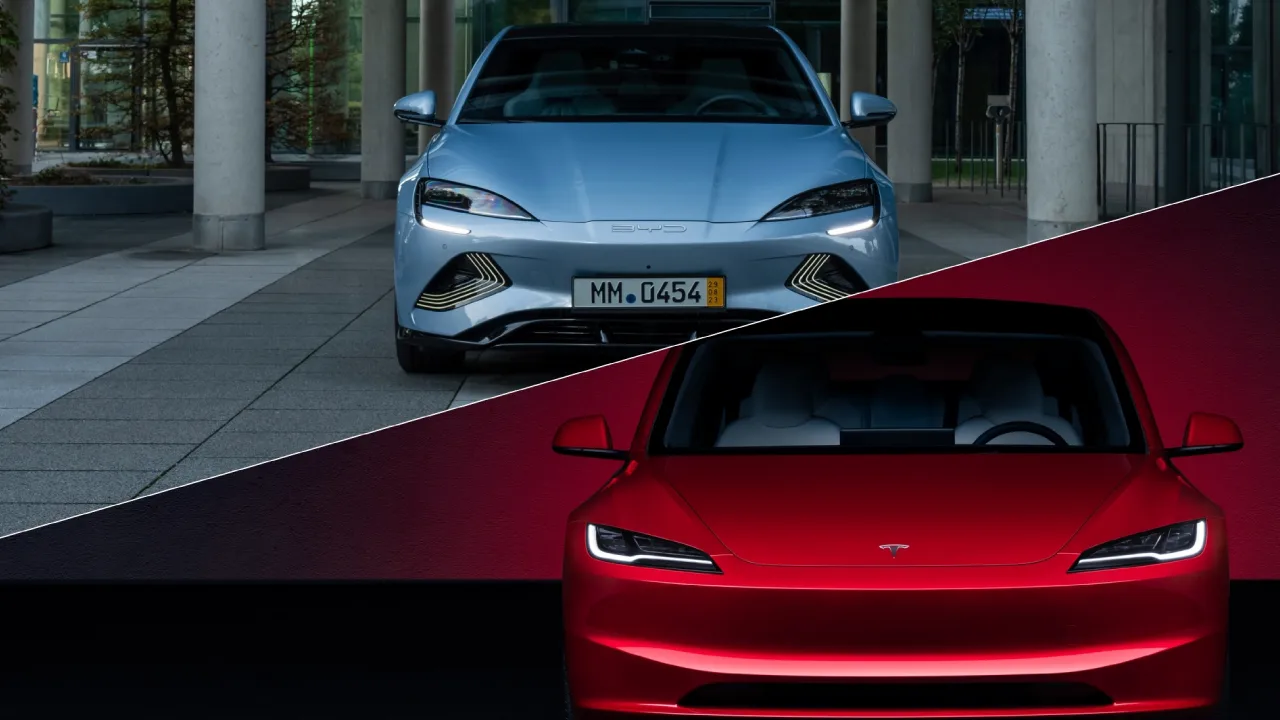
Quick Verdict: Tesla vs BYD at a Glance
Tesla wins on software, charging infrastructure, and long-distance usability. BYD wins on price, model variety, and pure sales volume. Your location matters enormously here.
U.S. buyers will find Tesla far easier to live with, thanks to the Supercharger network and stronger service coverage. European shoppers have more BYD options than ever. Buyers in China or Southeast Asia will find BYD’s value case almost impossible to argue against.
Neither brand wins outright. The better choice depends on your budget, your region, and whether software or savings ranks higher on your list.
Tesla vs BYD: Brand Overview
Tesla launched in 2003 with a clear thesis: build the best software-defined car, not just the best battery. Every model — the Model 3, Model Y, Model S, and Model X — runs on a deeply integrated tech stack that updates over the air, gets smarter over time, and treats the car as a connected platform. According to Tesla investor relations, the company delivered roughly 1.64 million battery electric vehicles globally in 2025, a number that surprised analysts on the downside but still reflected a dominant U.S. market position.
BYD tells a different story. Founded in 1995 as a battery manufacturer, it evolved into one of the world’s most vertically integrated automakers. BYD makes its own chips, its own batteries, and its own electric motors. BYD official company information shows a lineup spanning budget city cars to luxury sedans — with both battery electric vehicles (BEVs) and plug-in hybrids (PHEVs). In 2025, BYD sold over 2.25 million BEVs globally, edging Tesla for the first time in annual volume.
That gap reflects two very different strategies. Tesla concentrates on a small lineup at premium prices. BYD floods the market with variety across every price tier.
Price and Value Comparison
BYD is cheaper. That’s the straightforward answer.
Across equivalent vehicle classes — compact sedans, midsize SUVs, entry-level EVs — BYD typically undercuts Tesla by a meaningful margin, especially outside North America. The Atto 3, Seal, and Dolphin all sit in price ranges where Tesla has no direct competitor.
Understanding how much it costs to charge a Tesla adds important context to the ownership cost equation. Tesla’s charging network lets drivers avoid expensive third-party chargers on long trips, which reduces total operating costs over time. That partially offsets the higher sticker price.
Resale value is another factor. Tesla depreciation has historically been stronger than the broader EV market, though it’s worsened with recent price cuts. BYD’s residual values are harder to assess in Western markets because the brand is still building consumer familiarity. If you’re also wondering whether Tesla prices will go down further, the answer is: possibly, but don’t count on it closing the gap with BYD anytime soon.
For pure upfront cost, BYD wins. For total cost of ownership over five years, Tesla closes the gap significantly, particularly in regions where the Supercharger network eliminates premium third-party charging fees.
Range, Efficiency, and Real-World Usability
Tesla holds a range advantage in most head-to-head model comparisons. The Model 3 Long Range and Model Y Long Range consistently post real-world figures above 280 miles. BYD’s Seal and Atto 3 compete well in rated range, but independent tests sometimes show a larger gap between stated and real-world figures.
Cold weather hurts both brands. It always does. But how Tesla heats the cabin using a heat pump system rather than a resistive heater gives it a meaningful efficiency edge in winter conditions.
On urban commuting, BYD holds its own. Its energy efficiency in stop-start city driving is genuinely strong, and several models perform well on energy-per-mile metrics in temperate conditions. The difference between brands narrows considerably when you’re driving 30 miles a day in mild weather.
For long road trips, Tesla wins clearly. Its energy planning, real-time Supercharger routing, and consistent real-world efficiency make 500-mile days manageable. BYD simply can’t match that experience outside China right now.
Efficiency winner: Tesla. Range winner at equivalent price: often BYD.
Charging Speed and Charging Network
This is Tesla’s clearest win.
The Supercharger network spans over 50,000 connectors globally. It’s reliable, fast, and deeply integrated into Tesla’s navigation system. You’ll find the best Tesla Supercharger stations positioned near highways and urban centers in the U.S. and Europe, making long-distance planning stress-free.
Understanding Tesla charging adapters matters here. Tesla’s NACS connector is now being adopted across North America by Ford, GM, Rivian, and others. That means other cars can use Tesla chargers in many cases — which also expands charging access for the broader EV market while keeping Tesla central to the ecosystem.
For speed details, how fast Supercharger Tesla charges actually vary by model and station generation, with V3 Superchargers delivering up to 250 kW. That’s class-leading for a proprietary network.
BYD’s charging speed is competitive in China, where its 800V architecture on certain models enables very fast charging. Outside China, the picture is patchy. BYD relies on third-party public charging networks in Europe and other markets, which introduces variability in reliability and pricing. The U.S. EV charging resources from the Department of Energy highlight how fragmented non-Tesla charging infrastructure remains in North America — a real disadvantage for BYD shoppers there.
Charging winner: Tesla, decisively outside China.
Software, Infotainment, and Driver Assistance
Tesla’s software advantage is real and substantial.
The Tesla interface — centered on a large horizontal touchscreen in the Model 3 and Model Y — is mature, fast, and deeply functional. Over-the-air updates arrive regularly and genuinely improve the car. Features added post-purchase are common. The app integration, remote access, and energy monitoring tools are class leaders.
Does Tesla have Autopilot? Yes — standard on all new Teslas, with Full Self-Driving (FSD) available as an upgrade. Autopilot handles highway lane centering and adaptive cruise control confidently. FSD’s city-street performance continues to improve with each software release, though it still requires driver supervision.
One notable gap: Tesla doesn’t have Apple CarPlay. Tesla’s closed ecosystem means you use Tesla’s native apps, maps, and streaming services rather than mirroring your iPhone. That’s a dealbreaker for some buyers and a non-issue for others who prefer native integration.
BYD’s infotainment varies significantly by model and market. Chinese-market BYDs often run capable, feature-rich systems with large rotating screens and robust voice control. Internationally sold models sometimes receive simplified software with less polished user experiences. BYD’s driver-assistance suite — branded as DiPilot — is improving but lags Tesla’s Autopilot in real-world highway capability and update frequency.
Software winner: Tesla, by a wide margin.
Battery Technology, Safety, and Durability
BYD’s Blade battery is genuinely impressive. The lithium iron phosphate (LFP) cell-to-pack design eliminates traditional module packaging, improving energy density and dramatically reducing thermal runaway risk. BYD’s own nail-penetration tests on the Blade battery show it withstands extreme conditions that cause competing lithium-ion packs to fail catastrophically.
Tesla uses both LFP (in Standard Range models) and nickel manganese cobalt (NMC) chemistry in Long Range and Performance variants. Both chemistry choices are well-established. Tesla’s thermal management system is mature, with years of real-world data behind it.
For official vehicle safety information, NHTSA provides ratings and recall data for vehicles sold in the U.S. Tesla models consistently receive high safety scores. BYD’s U.S. presence is still limited, so NHTSA data for BYD vehicles is thinner.
Long-term battery durability data on BYD is younger than Tesla’s. Tesla has vehicles with 200,000+ miles showing less than 15% capacity degradation. Learning how many miles a Tesla battery lasts gives useful context for long-term ownership. BYD’s Blade battery carries strong early durability signals, but comparable long-term field data is still accumulating.
Battery tech winner: BYD’s Blade is innovative. Tesla wins on long-term field data.
Models, Variety, and Regional Availability
BYD offers far more choice. The lineup runs from the compact Seagull city car to the Han EV luxury sedan, the Tang SUV, the Atto 3, the Seal sport sedan, and the Dolphin hatchback. Add the plug-in hybrid models like the Song Plus DM-i, and BYD covers nearly every segment.
Tesla sells four models globally: the Model 3, Model Y, Model S, and Model X. The Cybertruck is U.S.-only. That’s it.
Regional availability changes everything. In China, BYD dominates. In Europe, BYD is growing fast, with the Atto 3 and Seal gaining registrations — European car registration data shows both brands converging in market share across key markets in H1 2026. In the U.S., BYD sells essentially nothing due to 100%+ import tariffs on Chinese-made EVs. Tesla has the U.S. market mostly to itself among Chinese-origin competitors.
If you’re shopping in Australia, Southeast Asia, Latin America, or the Middle East, BYD’s variety and pricing may genuinely suit you better than Tesla’s limited lineup.
Variety winner: BYD. Availability winner: Tesla in the U.S.
Who Should Choose Tesla?
Choose Tesla if you live in the U.S. or Western Europe and plan to drive long distances regularly. The Supercharger network solves the road-trip problem that still trips up other EVs.
Choose Tesla if software matters. The interface, over-the-air updates, Autopilot, and connected-car experience are genuinely better. Understanding Tesla maintenance needs also helps: Teslas require very little upkeep compared to combustion vehicles, with no oil changes and minimal brake wear due to regenerative braking.
Choose Tesla if you want a proven, high-volume resale market and established service infrastructure. Tesla’s brand recognition still commands a premium in most Western markets.
Tesla is the right call for: U.S. buyers, long-distance drivers, tech-first shoppers, and anyone prioritizing charging convenience.
Who Should Choose BYD?
Choose BYD if budget is the primary driver. You’ll get more car for less money, often with competitive specs and a well-built interior at a lower price point than any comparable Tesla.
Choose BYD if you’re in China, Southeast Asia, Australia, or markets where the brand has strong dealer networks and local charging support. The value case is strongest where BYD has real infrastructure behind it.
Choose BYD if you want a plug-in hybrid option. Tesla offers no PHEVs. BYD’s DM-i lineup lets drivers cover short distances on electricity and longer trips on petrol without range anxiety — a practical middle ground for buyers not yet ready to go fully electric.
BYD is the right call for: budget buyers, PHEV shoppers, buyers outside the U.S., and anyone who wants more model variety.
Comparison Table
| Feature | Tesla | BYD |
|---|---|---|
| Price positioning | Premium | Budget to premium |
| Model variety | 4 global models | 20+ models globally |
| Charging network | Supercharger (extensive) | Third-party (patchy outside China) |
| Software quality | Industry-leading | Improving, region-dependent |
| Driver assistance | Autopilot / FSD | DiPilot (capable, less mature) |
| Battery tech | LFP + NMC (proven) | Blade LFP (innovative) |
| U.S. availability | Full | Extremely limited |
| PHEV options | None | Extensive |
| Long-distance usability | Excellent | Good in China, variable elsewhere |
| Resale value | Established | Still developing in Western markets |
FAQ
Is Tesla better than BYD?
Tesla is better for software, charging, and long-distance driving. BYD is better for price, variety, and markets outside North America. Neither is universally superior.
Is BYD cheaper than Tesla?
Yes, across most comparable segments. BYD’s lineup includes models with no Tesla equivalent at that price point.
Which brand has better range?
Tesla generally leads in real-world range, particularly on highway driving. BYD’s rated range is competitive but independent tests show larger real-world variation.
Which is safer?
Both brands have strong safety records. Tesla has more verified long-term safety data from NHTSA and EURO NCAP. BYD’s Blade battery is genuinely innovative in thermal safety.
Which is better for long-distance driving?
Tesla, clearly. The Supercharger network makes planning and executing long trips significantly easier than relying on third-party charging.
Final Verdict
Tesla wins on software, charging, and long-distance ownership — and it’s the only real choice for U.S. buyers right now. BYD wins on price, variety, and volume, and it’s genuinely competitive for buyers in markets where the brand has strong local infrastructure.
The EV race between these two brands is dynamic. BYD outsold Tesla globally in 2025 by BEV count. Tesla still generates more revenue per vehicle and holds stronger software differentiation. Both are credible.
Pick Tesla if you prioritize the full ecosystem experience. Pick BYD if you want more car for less money — and your market actually sells it.