What Does JK Stand For? Jeep Wrangler Generations Explained

If you’ve been browsing used car listings or Jeep forums, you’ve probably seen “JK” thrown around like everyone knows what it means. Here’s the short answer: JK is Jeep’s internal chassis code for the third-generation Wrangler, covering model years 2007 through 2018. It’s not an acronym. It’s an alphanumeric platform designation — a standardized code used internally to identify a specific generation of vehicle across all trim levels and configurations.
Once you understand that, a lot of Jeep shorthand starts to make sense.
What Does JK Stand For? (Quick Answer)
The JK Wrangler rolled off production lines from 2007 to 2018, replacing the TJ generation (1996–2006) and eventually giving way to the current JL generation (2018–present). According to the third-generation Wrangler specifications on Wikipedia, the JK represented a complete ground-up redesign — not a refresh of the previous platform.
JK applies to every Wrangler built during that 12-year window. It doesn’t matter whether you’re looking at a base Sport trim or a fully loaded Rubicon. If it’s a 2007–2018 Wrangler, it’s a JK. That consistency is the whole point of using a platform code.
You’ll encounter “JK” most often in used car listings, aftermarket parts catalogs, Jeep forums, and repair guides. It immediately tells technicians, sellers, and enthusiasts which generation they’re dealing with — no guessing required.
Why Does Jeep Use Chassis Codes?
Manufacturers use platform codes to standardize identification across model years, trim levels, and powertrains. It makes parts compatibility, repair documentation, and buyer communication far more efficient.
Jeep’s Wrangler lineage follows this progression:
- CJ series — 1945 to 1986
- YJ — 1987 to 1995
- TJ — 1996 to 2006
- JK — 2007 to 2018
- JL — 2018 to present
For the complete generational Jeep lineage, each code represents a distinct platform — different chassis geometry, engineering specifications, and sometimes entirely different powertrains. You can explore generational codes explained for all Jeep models in more technical depth if you want to go deeper into the naming system.
The bottom line? Knowing a Wrangler’s generation code helps you buy smarter, wrench smarter, and shop smarter.
What Made the JK Special?
The JK wasn’t just a new model year. It was a full platform reinvention.
Jeep introduced several significant changes with the JK generation. The most notable was the four-door “Unlimited” variant. Before the JK, the Wrangler was primarily a two-door vehicle appealing to hardcore off-road enthusiasts. The four-door Unlimited opened the market to families and buyers who wanted adventure capability without sacrificing practicality.
The JK also brought stronger axles, an updated suspension system, and a new 3.8L V6 engine (later upgraded to the more capable 3.6L Pentastar V6 in 2012). These changes made the JK one of Jeep’s highest-selling models during its 12-year production run — over 1.4 million units sold globally.
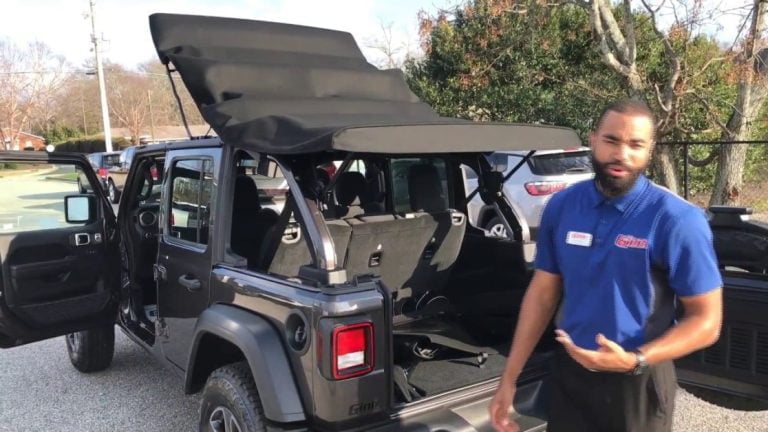
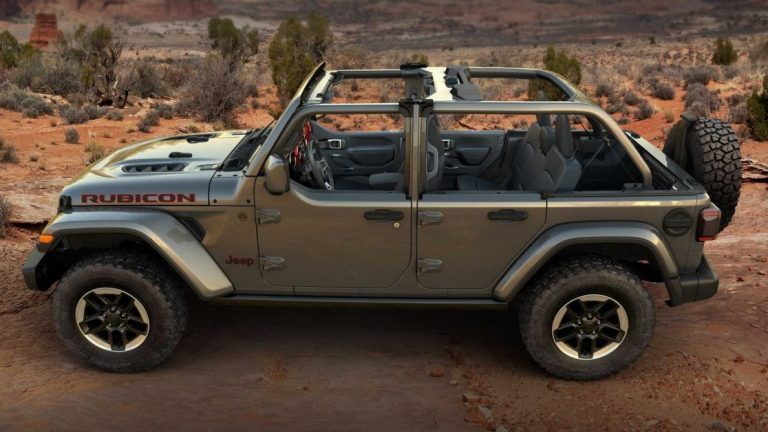
Trim variety played a big role, too. The Sport, Sahara, and Rubicon trims gave buyers genuine options. The Rubicon, in particular, remains a benchmark for factory off-road capability. Want to push your JK further? The best lift kit for a Jeep Wrangler remains one of the most popular upgrades among JK owners. And one of the JK’s most beloved features is still fully intact: you can take the Jeep Wrangler doors off for open-air driving without any specialized tools. For JK owners who park outdoors, a quality Jeep Wrangler cover helps protect that investment year-round.
JK vs. JL: What’s the Difference?
The JL generation launched in 2018 and overlapped briefly with the final JK production year. Both generations offer two-door and four-door Unlimited configurations, but the similarities largely stop there.
The JL introduced a turbocharged four-cylinder engine option, a mild-hybrid eTorque system, significantly improved interior quality, and updated technology across all trims. It also refined aerodynamics and reduced wind noise — something JK owners know well.
The JK, meanwhile, remains extremely popular on the used market. It’s simpler mechanically, parts are widely available, and it’s generally more affordable. If you’re maintaining a used JK, sourcing a best Jeep Wrangler oil filter matched to your engine year is a smart starting point. Curious about what comes after the JL? Check out when the 2026 Jeep Wrangler comes out for the latest on the next generation’s timeline.
The Bottom Line
JK = third-generation Jeep Wrangler, built from 2007 to 2018. It’s a platform code, not an acronym, and it’s used universally across trims, variants, and model years within that window. Understanding this system helps you decode listings, find the right parts, and have smarter conversations about one of the most iconic vehicles ever built.