How to Recharge Jeep Renegade AC: Safe Step-by-Step Guide


If your Jeep Renegade is blowing warm air, low refrigerant may be the cause — but it’s not always the whole story. The safest DIY fix is to verify your refrigerant type, connect to the low-pressure port, and add refrigerant slowly while watching the gauge. This guide walks you through every step, including how to spot a deeper problem before you waste refrigerant on a system that needs a repair, not a top-off.
Jeep Renegade AC Recharge: What You Need to Know First
Weak cooling doesn’t always mean low refrigerant. A dirty cabin air filter, a faulty compressor, or an electrical issue can all reduce airflow or cooling without touching refrigerant levels.
Check the low AC refrigerant symptoms first. Look for warm air from vents on a hot day, a compressor that clicks off immediately after starting, or a system that blows cold for a few minutes then fades.
Those are the classic signs. They don’t always confirm a low charge, but they point you in the right direction.
One critical rule before you touch anything: don’t add refrigerant if the compressor isn’t engaging at all. A clutch that won’t click on often signals a mechanical fault or a safety cutout triggered by critically low pressure. Adding refrigerant into a seized or damaged compressor makes the problem worse.
Signs Your AC Is Low on Refrigerant
- Vents blow cool but not cold air
- Cooling is worse on extremely hot days
- Compressor cycles on and off rapidly
- AC performance improved after the last recharge but faded within weeks
Why “Recharge” Is Not Always a Complete Fix
Refrigerant doesn’t evaporate under normal conditions. If your system is low, there’s a leak somewhere. A recharge buys time — it doesn’t fix the root cause. If cooling fails again within a few weeks, the system needs a leak test, not another can of refrigerant.
Check the Refrigerant Type and Factory Charge Before You Start
This step is non-negotiable. Using the wrong refrigerant damages the AC system and voids any warranty on components.
Most Jeep Renegade models from 2015 onward use R-1234yf, not the older R-134a. That’s a meaningful difference. R-1234yf requires specific recharge kits that aren’t interchangeable with R-134a equipment.
Check the Jeep Renegade AC system service guide and confirm against the under-hood sticker near the AC compressor or on the firewall. That sticker lists the refrigerant type and the factory charge weight in grams.
The air conditioning refrigerant capacity varies slightly depending on the model year and engine. A 2021 Renegade with the 1.3L turbo typically holds around 400–420g of R-1234yf. Don’t guess — read the label.
Where to Find the AC Label
Open the hood and look for a sticker on the top or side of the AC compressor, or on the firewall near the engine bay. It lists refrigerant type, charge weight, and sometimes oil type.
Why Refrigerant Type Matters
Mixing refrigerants contaminates the system. Shops will refuse to service a contaminated system without a full flush — which costs several hundred dollars. Get the type right before you buy a recharge kit.
| Refrigerant Type | Common Renegade Years | Approx. Charge Weight |
|---|---|---|
| R-1234yf | 2015–present (most models) | 400–430g |
| R-134a | Some early 2015 variants | Verify via under-hood label |
Locate the Low-Pressure AC Service Port on a Jeep Renegade
The low-pressure port sits on the larger-diameter AC line — the suction side of the system. On the Renegade, it’s typically found near the firewall or along the line running from the evaporator toward the compressor.
This Jeep Renegade AC recharge guide shows the exact port position for common model years. The low-side port has a blue or black cap in most cases, and the port itself is smaller in diameter than the high-side fitting.
Never connect to the high-pressure port. It’s on the smaller-diameter line between the condenser and the expansion valve. Connecting a recharge kit there can cause the can to rupture or push refrigerant the wrong direction through the system.
Low-Pressure Port Identification Tips
- Look for the larger AC line in the engine bay
- Cap is usually blue, black, or labeled “L” or “LOW”
- The port accepts a snap-on coupler without tools
- It’s distinct from the high-side port — the fittings are different sizes by design
High-Pressure Port Safety Warning
The high-side port will often have a red cap. Don’t touch it during a DIY recharge. It’s under high pressure even when the engine is off, and connecting incorrectly there is dangerous.
Gather the Right Tools and Safety Gear
Don’t skip personal protection. Refrigerant contacts your skin at extremely low temperatures and can cause frostbite within seconds.
You’ll need safety glasses, nitrile gloves, and a recharge kit matched to your refrigerant type — either R-1234yf or R-134a depending on your model year. Kits like the AC Pro R-1234yf or Interdynamics Arctic Freeze come with an integrated pressure gauge hose, which is essential for safe charging.
A digital thermometer helps you verify vent temperature before and after. That’s your confirmation the job actually worked.
For broader Jeep maintenance context, it’s worth checking what other services cost. Understanding how much is a Jeep Wrangler oil change or browsing the Best Jeep Wrangler Oil Filters of 2026 can help you budget across all routine upkeep. And if you’re also wondering about other Jeep ownership costs like how much are Jeep Wrangler tires, those resources offer solid pricing baselines.
What Comes in a Basic Recharge Kit
- Refrigerant canister (sized for one recharge)
- Gauge-equipped hose with coupler
- Instructions for pressure ranges by temperature
Step-by-Step Jeep Renegade AC Recharge Process
Work through these steps in order. Skipping ahead leads to overcharging or inaccurate pressure readings.
Step 1: Prepare the Vehicle
Park on level ground. Turn the engine off. Shake the recharge canister for 30 seconds and attach it to the hose if not pre-attached. Put on your glasses and gloves. Do not connect the coupler yet.
Step 2: Connect the Recharge Kit
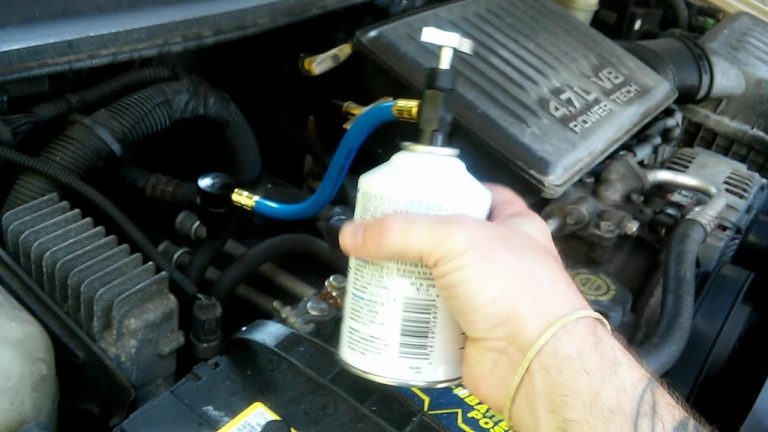
Locate the low-pressure port. Remove the cap and set it somewhere you won’t lose it. Snap the coupler firmly onto the port — it clicks into place. Don’t force it. If it won’t seat, you may be on the wrong port.
Step 3: Read System Pressure
Start the engine. Set AC to max cold, highest fan speed, and switch recirculation mode on. Wait 60 seconds for pressures to stabilize, then read the gauge without adding refrigerant.
A reading below 25 psi on a day above 70°F suggests a low charge. A reading of 0 psi means the system may have lost almost all refrigerant — possibly from a significant leak.
Step 4: Add Refrigerant Slowly
Hold the canister upright. Dispense refrigerant in 5-second bursts. Check the gauge between each burst. The target pressure depends on ambient temperature — on a 90°F day, you’re aiming for roughly 45–55 psi on the low side.
Don’t rush this. Adding too fast means you’ll overshoot the target before the gauge catches up.
| Ambient Temp (°F) | Target Low-Side Pressure (psi) |
|---|---|
| 65 | 25–35 |
| 75 | 35–45 |
| 85 | 45–55 |
| 95+ | 50–60 |
Step 5: Finish and Test Cooling
Stop adding refrigerant when the gauge reads within the target range. Disconnect the coupler. Reinstall the port cap immediately. Check vent temperature with your thermometer — you should see 40–55°F at the center vent on a hot day if the system is charged correctly.
That’s a solid result. If the air is still warm, the system likely has another problem beyond low refrigerant.
How to Tell If Your Jeep Renegade AC Is Properly Charged
A properly charged system delivers steady cold air within 2–3 minutes of startup. The compressor cycles normally — on for 5–10 seconds, off briefly, then back on.
Watch for overcharge symptoms too. If the low-side pressure is above 60 psi, the compressor may shut off entirely as a protection measure. The air gets warm. This feels like undercharge, but adding more refrigerant makes it worse.
Pressure Clues
- Too low: compressor cycles on/off rapidly, air barely cool
- Normal: steady compressor operation, gauge stable in target range
- Too high: compressor won’t engage, gauge reading above 60 psi
Cooling-Performance Clues
- Vent temp above 60°F after 5 minutes: system still undercharged or has another fault
- Vent temp drops below 45°F: good charge, functioning system
- Cooling fades within 20 minutes: likely a refrigerant leak still present
Common Jeep Renegade AC Recharge Mistakes to Avoid
These mistakes cost money and can damage an expensive AC system.
Overcharging is the most common DIY error. More refrigerant doesn’t mean more cooling — it means a compressor cutout and a shop visit to recover the excess.
Using the wrong refrigerant contaminates the system. Don’t assume your Renegade uses R-134a because your previous car did.
Charging with the engine off or the AC set to low fan gives you a false pressure reading. The compressor must be running for accurate data.
For reference on how to handle other Jeep repair jobs methodically, see the guide on How to Replace a Jeep Starter — it shows the same safety-first preparation approach that applies to AC work.
- Never connect to the high-pressure port
- Never add refrigerant without reading baseline pressure first
- Never ignore a system that goes low again within two weeks
- Never mix refrigerant types in the same system
- Never charge a system where the compressor won’t engage
When to Stop DIY and Use a Professional Shop
Some AC problems are beyond a top-off. Know when to stop.
If the system loses its charge again within a month, there’s a leak. A professional can perform a dye test or electronic leak detection to find it. Patching a leak costs more than a recharge, but it’s the only real fix.
A compressor that won’t spin at all — even with a correctly charged system — points to an electrical fault or a seized compressor. That’s not a DIY job. Review the AC recharge cost estimate to compare DIY vs. shop pricing. A full professional evacuation and recharge typically runs $150–$300. A compressor replacement can reach $800–$1,200 depending on labor rates.
For perspective on major Jeep repairs, How Much Does It Cost to Regear a Jeep Wrangler? and How Much Is a Jeep Wrangler Bumper illustrate how quickly professional service costs escalate. Are the Jeep Wranglers Reliable? also covers general Jeep mechanical ownership context. And for another troubleshooting scenario where diagnosis beats guessing, see How to Get Jeep Compass Out of Limp Mode?
Signs of a Leak
- System goes low again within 2–4 weeks
- Oily residue around AC line fittings or compressor shaft
- Visible dye staining under UV light (if prior dye was added)
When a Repair Is More Than a Recharge
- Compressor not engaging after confirmed correct pressure
- Visible AC line damage or fitting corrosion
- System at 0 psi — total loss suggests major leak or line failure
Jeep Renegade AC Recharge FAQ
How much refrigerant does a Jeep Renegade take?
Most Renegades with R-1234yf hold 400–430 grams. Always verify against the under-hood label — don’t rely on a general estimate for your specific model year and engine.
Can you recharge it without a gauge?
No. Adding refrigerant blind risks overcharging. Overcharged systems cut compressor power as a safety measure, making the AC worse. A gauge hose is inexpensive and included in most recharge kits.
Why does the AC get warm again after a recharge?
The refrigerant escaped somewhere. The system leaks — in a fitting, line, condenser, or compressor seal. A recharge is a temporary solution without a leak repair.
How do you know if the AC leaks?
A UV dye test is the most reliable DIY method. Add dye to the system, run the AC for 15 minutes, then scan with a UV light. Green staining appears at the leak point.
Is R-1234yf safe to recharge at home?
Yes, with proper precautions — gloves, glasses, and working outdoors or in a ventilated space. R-1234yf is mildly flammable, so keep it away from heat sources and never work near an open flame.
For Jeep owners exploring related maintenance, the guide on Best All Terrain Tires for Jeep Wrangler is a useful next read for overall vehicle upkeep planning.
Final Checks and Next Steps
Reinstall the low-pressure port cap snugly. It prevents debris from entering the port and maintains pressure over time.
Check the vent temperature once more after a 5-minute drive. Record the refrigerant type, charge amount, and date in a maintenance log. If cooling fades again in the next few weeks, book a leak inspection — don’t just add another can.
A successful AC recharge is straightforward when you follow each step. Get the refrigerant type right, use the low-side port, add slowly, and stop at the target pressure. That’s the whole job. For more Jeep ownership cost planning, see How Much Is It to Paint a Jeep Wrangler? as another example of where DIY vs. shop decisions matter.