
Tesla vs Rivian: Which EV Is Better in 2026?

Quick Verdict: Tesla or Rivian?
Tesla wins for most buyers. It offers better charging access, stronger efficiency, lower entry pricing, and a more mature software ecosystem. Rivian wins for adventure-focused buyers who need a capable electric truck or premium SUV with genuine off-road ability and a more practical, traditional cabin layout.
The brands don’t fully overlap — Model Y shoppers won’t find a true Rivian equivalent, and R1T buyers have no Tesla truck alternative yet. Your best choice depends almost entirely on what you do with your vehicle.
Tesla vs Rivian at a Glance
Tesla’s vehicle lineup spans four core models: Model 3, Model Y, Model S, and the Cybertruck. That breadth gives buyers real choices across sedans, crossovers, performance flagships, and a polarizing electric pickup. Tesla targets a wide buyer base, from daily commuters to performance enthusiasts.
Rivian’s vehicle lineup is tighter. The R1T truck and R1S SUV lead the brand, with the smaller R2 SUV arriving to expand reach. Rivian targets adventure-driven buyers who want premium utility and genuinely rugged capability. Price tiers start higher than Tesla’s entry point.
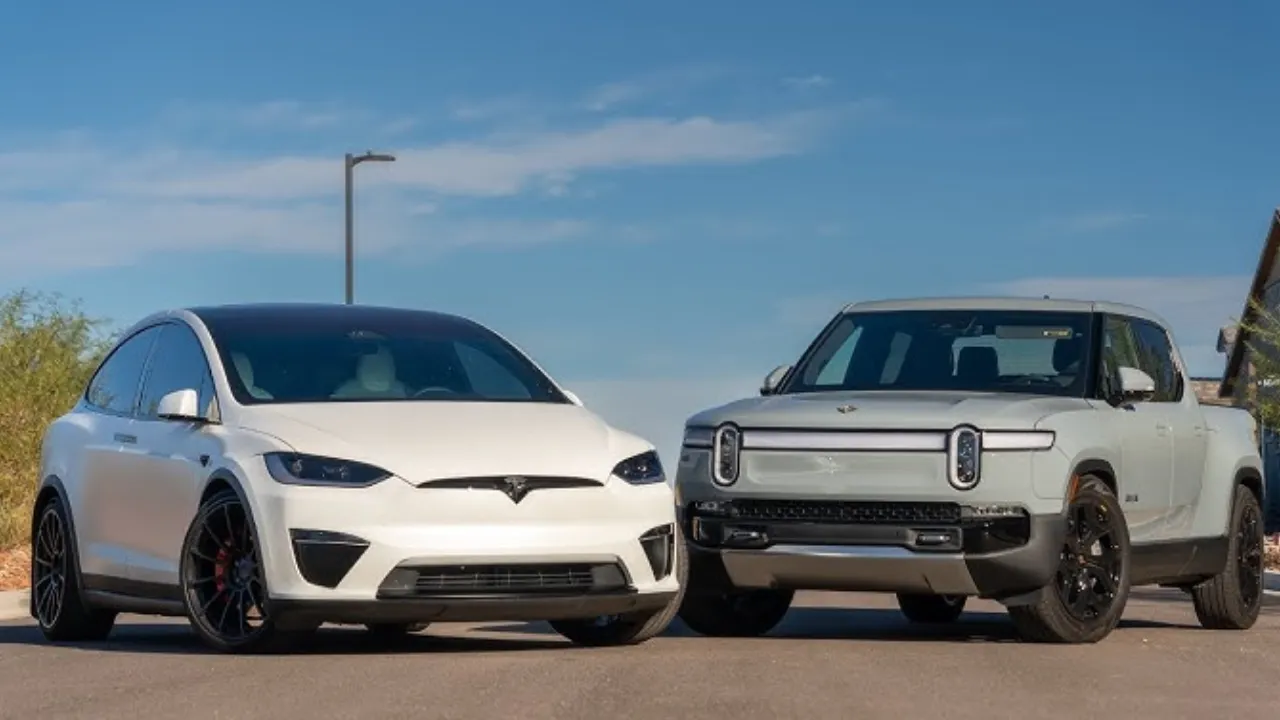
The brands overlap most directly in two matchups: Model Y vs R1S and Cybertruck vs R1T. Outside those pairings, they’re not competing for the same buyer. If you’re also considering a Ford alternative, the ford mach e vs tesla model y comparison is worth reading alongside this one.
Price and Value Proposition
Tesla has a clear advantage at the lower end. The Model 3 and Model Y sit in the mainstream EV price tier, making them accessible to a broader market. The Model S pushes into luxury territory, but most buyers don’t need it.
Rivian starts in the premium-to-luxury tier. The R1S and R1T are not budget vehicles. The upcoming R2 will bring Rivian closer to the mainstream, but for now, shoppers entering at Rivian’s standard price point are spending more than a Model Y buyer.
What do you get for the premium? Rivian delivers more physical capability — better towing, genuine off-road hardware, and a premium interior. Tesla delivers better software, charging convenience, and a proven efficiency edge. The gap narrows when you weigh Rivian’s utility features against Tesla’s long-term ownership savings.
Neither brand offers exceptional value at the very top of its lineup. But Tesla wins on value-per-dollar for everyday driving. Rivian wins when you need what it specifically does well.
Range, Efficiency, and Real-World Driving
Tesla Range by Model
Tesla’s efficiency leadership is real. The Model 3 Long Range reaches approximately 358 miles EPA-rated. The Model Y Long Range sits near 320 miles. Even the Cybertruck delivers respectable range in its Long Range configuration. According to EPA range data, Tesla consistently ranks among the most efficient EVs by watt-hour per mile in each segment.
Real-world numbers dip on the highway — typically 10–15% below EPA ratings at 70 mph. Still strong.
Rivian Range by Model
The R1S and R1T offer competitive range figures, particularly in Max Pack configurations. R1S Max Pack is rated near 410 miles EPA. However, Rivian’s larger, heavier vehicles consume more energy per mile. Real-world highway range, especially with wind resistance from the truck body, tends to fall more sharply than Tesla’s aerodynamic models.
Body shape matters here. The R1T’s truck bed and upright profile hurt aerodynamic efficiency. Tesla’s vehicles, especially the Model 3, benefit from a low drag coefficient that protects real-world range.
For pure range consistency, Tesla wins. For maximum range in a premium SUV, the R1S Max Pack is genuinely impressive.
Charging Experience and Network Access
Tesla Charging Network Advantage
Tesla’s Supercharger network remains the gold standard. Over 50,000 Supercharger stalls operate globally, with speeds reaching up to 250 kW on V3 hardware. For full details on charging speeds and rates, see Tesla charging support. The network’s density means Tesla drivers rarely plan trips around charger availability.
You can get deeper numbers on exactly how fast is Supercharger Tesla hardware delivers in practice, and it’s genuinely impressive on long routes. Understanding how much does it cost to charge a Tesla is also worth knowing before comparing running costs to Rivian ownership.
Third-party EV drivers can now access Superchargers, too. If you’re wondering can other cars use Tesla chargers, the answer is yes — through the NACS adapter rollout.
Rivian NACS Transition and Public Charging
Rivian has added NACS ports to its 2024+ vehicles. That’s a significant upgrade. Rivian owners now access the Supercharger network directly. For complete details, Rivian charging access outlines available network partners and adapter options.
Rivian also operates its own Adventure Network, with fast chargers placed at outdoor recreation destinations. It’s clever positioning — but the network is far smaller than Tesla’s.
Charging is still a Tesla advantage. But the gap is closing faster than many buyers realize.
Performance, Towing, and Capability
Highway Performance
Both brands deliver strong acceleration. Tesla’s Model S Plaid hits 0–60 mph in under 2 seconds. Model Y Performance sits near 3.5 seconds. These are fast vehicles by any standard.
Rivian’s R1S and R1T are no slouches. Dual-motor R1T hits 0–60 mph in around 3.5 seconds. The Quad-Motor R1S does it in approximately 3.0 seconds. That’s supercar territory in an SUV body.
On pure road performance, Tesla and Rivian are closer than buyers expect.
Towing and Utility
This is where the comparison shifts. Rivian’s R1T tows up to 11,000 lbs. The R1S tows up to 7,700 lbs. The Cybertruck’s specs have been revised multiple times, so check current Tesla figures directly — but it’s broadly competitive in the electric truck class.
Rivian is built for utility. The truck bed, gear tunnel, front trunk, and integrated air compressor on R1T and R1S make them genuinely useful for work and adventure hauling.
Off-Road and Trail Readiness
Rivian wins here. Full stop. Air suspension, individual motor torque control, all-terrain tires, and tank-turn capability make R1T and R1S among the most capable stock off-road EVs available. Both vehicles carry official safety ratings that confirm structural integrity under real-world stress.
Tesla’s vehicles are not off-road vehicles. The Cybertruck has some off-road features, but it’s not in the same category as a properly equipped R1S.
Interior, Infotainment, and Software
Tesla Software and Interface
Tesla’s cabin is minimal. Almost everything runs through a central touchscreen — climate, media, navigation, even the glove box. It’s a deliberate design philosophy, and for many owners it works well. Understanding how Tesla car works explains why software sits at the center of the entire ownership experience.
Over-the-air updates add features continuously. The infotainment system is fast, responsive, and regularly improved. Tesla also offers Autopilot as standard, with Full Self-Driving available as an upgrade — a meaningful differentiator in the driver-assistance space.
Note that Tesla does not support Apple CarPlay or Android Auto. That’s a genuine drawback for some buyers.
Rivian Cabin Design and Practicality
Rivian’s interior feels more traditional but still modern. Physical controls exist alongside the center touchscreen. The layout is more intuitive for buyers transitioning from conventional trucks or SUVs.
Build quality on Rivian’s interior has impressed most reviewers. Materials feel premium. Storage is generous, especially across the R1T’s innovative gear tunnel and front trunk combination.
Rivian’s software is improving rapidly with each update, but it’s less mature than Tesla’s. Expect that gap to narrow over the next two years.
Reliability, Maintenance, and Ownership Costs
Maintenance Needs
EVs require far less maintenance than combustion vehicles. No oil changes. No spark plugs. Fewer brake jobs due to regenerative braking. Knowing do Teslas need maintenance beyond basic upkeep is important — the answer is yes, but far less than you’d expect from a traditional vehicle.
Tesla’s maintenance requirements are well-documented after more than a decade of consumer data. Tire rotation, cabin air filter replacement, and occasional brake fluid checks cover most of it.
Rivian’s maintenance record is shorter simply because the brand is newer. Early owner data suggests similar low-maintenance expectations, but the sample size is smaller.
Service and Repairs
Tesla operates a network of service centers and mobile service vans. For many minor repairs, a technician comes to you. That’s a real convenience advantage. Check how much does Tesla mobile service cost for a sense of what routine service actually runs.
Rivian’s service network is growing but remains more limited geographically. If you live far from a major metro, Rivian service access could be a friction point.
Depreciation and Resale
Tesla’s depreciation story is mixed. Early models held value well, but aggressive price cuts in recent years compressed resale prices significantly. The full picture on do Teslas depreciate shows more nuance than most buyers expect.
Rivian’s resale data is still thin. Early indications show decent retention, but the brand’s long-term resale position remains unclear.
For buyers focused on long-term durability, do Teslas last a long time covers what the ownership data actually shows across hundreds of thousands of vehicles.
Which Brand Should You Choose?
Choose Tesla if you:
- Prioritize charging convenience on road trips
- Want the lowest EV entry price in the segment
- Value a mature, software-first driving experience
- Mostly drive on roads and highways
- Want the broadest model selection in the EV market
Choose Rivian if you:
- Need a capable electric truck or premium adventure SUV
- Tow regularly or haul heavy gear
- Go off-road or camp frequently
- Prefer a more traditional cabin with physical controls
- Want a premium feel with genuine utility credentials
If you’re considering trading in an existing vehicle toward a Tesla purchase, does Tesla do trade in explains how the process works and what to expect on valuation.
The right choice isn’t about which brand is “better.” It’s about which vehicle matches your actual life.
Tesla vs Rivian FAQ
Is Tesla better than Rivian?
Tesla is better for most daily drivers, commuters, and road-trip-focused buyers. It offers more charging stations, stronger efficiency, and a lower starting price. Rivian is better for buyers who need genuine truck capability, towing strength, or serious off-road performance.
Is Rivian more reliable than Tesla?
Tesla has more long-term ownership data. Early quality control issues affected both brands, but Tesla’s service network and repair history are more established. Rivian is improving rapidly, but it’s a younger company with fewer vehicles in the field.
Which is better for road trips?
Tesla. The Supercharger network is denser, faster, and more predictable than any alternative charging solution. Rivian owners with NACS-compatible vehicles can now access Superchargers, which significantly levels the playing field — but Tesla still has the routing software edge.
Do the brands compete directly?
Only partially. Model Y vs R1S and Cybertruck vs R1T are the closest matchups. Tesla has no equivalent to Rivian’s off-road focus, and Rivian has no equivalent to Tesla’s Model 3 sedan or Model S performance flagship.
Final Verdict
Tesla wins more use cases for more buyers. Better charging, lower entry cost, proven software, and a decade of ownership data give it a practical edge that’s hard to argue with.
Rivian wins decisively for adventure and utility buyers. The R1T and R1S are exceptional electric vehicles that do things no Tesla can match — towing, trails, and genuine outdoor capability.
Don’t let brand preference make this decision. Pick the vehicle that fits your actual driving life. For most people, that’s a Tesla. For buyers who camp, tow, or go off-road, Rivian is worth every premium dollar.
Tesla vs Rivian Comparison Table
| Feature | Tesla | Rivian |
|---|---|---|
| Entry price tier | Mainstream | Premium |
| Best range model | Model 3 Long Range (~358 mi) | R1S Max Pack (~410 mi) |
| Charging network | Supercharger (50,000+ stalls) | NACS + Adventure Network |
| Charging speed (peak) | Up to 250 kW | Up to 200 kW |
| Towing capacity | Up to ~11,000 lbs (Cybertruck) | Up to 11,000 lbs (R1T) |
| Off-road capability | Limited | Strong |
| Software maturity | High | Developing |
| Interior style | Minimalist | Premium traditional |
| Service network | Established, nationwide | Growing, metro-focused |
| Apple CarPlay/Android Auto | No | No |
| Driver assistance | Autopilot (standard) | Driver+ (standard) |
| Lineup breadth | Wide (4+ models) | Narrow (2–3 models) |