How to Check Transmission Fluid on Jeep Compass (Step-by-Step Guide)

Checking your Jeep Compass transmission fluid prevents costly repairs and keeps your vehicle shifting smoothly. This straightforward maintenance task takes 10-15 minutes and can save you thousands in potential transmission damage. Whether you drive a CVT-equipped model or the newer 9-speed automatic, understanding proper fluid check procedures protects your investment.
Why Check Jeep Compass Transmission Fluid Regularly?
Your transmission fluid serves as both a lubricant and a hydraulic medium, enabling smooth gear changes and power transfer from the engine to the wheels. Low or degraded fluid causes delayed shifts, slipping gears, and grinding sensations during acceleration. Jeep recommends checking transmission fluid every 30,000 miles or every two years, whichever comes first.
Neglecting this simple check leads to expensive consequences. Transmission repairs typically cost $2,000-$4,000, while a complete replacement can exceed $5,000. Warning signs include burning smells, reddish-brown puddles under your vehicle, or the transmission warning light illuminating on your dashboard.
Tools & Materials Needed
Gathering the right supplies before starting saves time and ensures accurate results. You’ll need clean rags or shop towels, a funnel with a long spout, and the correct transmission fluid type for your model year.
- Clean lint-free rags for wiping the dipstick
- Long-neck funnel for adding fluid
- Approved ATF (Mopar CVTF+4 for CVT models, ATF+4 for conventional)
- Jack and jack stands (if accessing sealed plug)
- Scan tool or OBD2 reader (for CVT temperature readings)
- Work gloves and a flashlight
- Wheel chocks for safety
Fluid Types by Model Year
Compass models from 2007-2016 with CVT transmissions require Mopar CVTF+4, specifically formulated for continuously variable transmissions. The 2017-2023 models with 9-speed automatics use standard Mopar ATF+4. Using incorrect fluid voids your warranty and damages transmission components. Check your owner’s manual or the transmission dipstick cap for specifications.
Preparation Steps Before Checking
Park your Compass on level ground to ensure accurate readings. An incline causes fluid to pool unevenly, resulting in false low or high measurements. Warm the engine to operating temperature by driving 10-15 minutes, as transmission fluid expands when hot, and dipsticks are calibrated for this condition.
Engage the parking brake firmly and place wheel chocks behind the rear tires for additional safety. Some models require the engine running while checking the fluid, while others need it off. Your owner’s manual specifies the correct procedure for your year.
Model Differences (CVT vs. 9-Speed)
CVT-equipped Compass models (2007-2016) feature a dipstick located on the driver’s side of the engine bay, typically near the battery. The dipstick has “COLD” and “HOT” markings for temperature-based readings. Newer 9-speed models (2017+) often have sealed transmissions requiring dealer-level scan tools to check fluid temperature between 40-50°C for accurate measurement. Some sealed systems require removing a check plug on the transmission case itself.
Step-by-Step Guide to Check Fluid Level
Remove the dipstick and wipe it completely clean with a lint-free rag. Reinsert the dipstick fully until it seats, then pull it out again to read the level. Fluid should register between the lower and upper “HOT” marks when the transmission is at operating temperature (160-180°F).
Examine the fluid color and smell while the dipstick is out. Healthy transmission fluid appears bright red or pink with a slightly sweet petroleum smell. Dark brown or black fluid indicates oxidation and contamination requiring immediate fluid change. A burnt odor signals overheating damage.
For CVT models, proper fluid temperature is critical. The fluid must be between 28-41mm on the dipstick when measured at 104-122°F (40-50°C). Using an OBD2 scan tool to monitor actual transmission temperature ensures accuracy. Cold readings give false low results.
No Dipstick? Check Plug Method
Sealed transmission systems require lifting the vehicle safely on jack stands. Locate the check plug on the transmission case (consult your service manual for exact location). Remove the plug with a 3/8″ ratchet or hex socket. Fluid should trickle out slowly when at the proper level and temperature. If no fluid appears, the level is low. Add fluid through the fill plug higher on the transmission case until it begins dripping from the check hole.
How to Add Transmission Fluid Safely
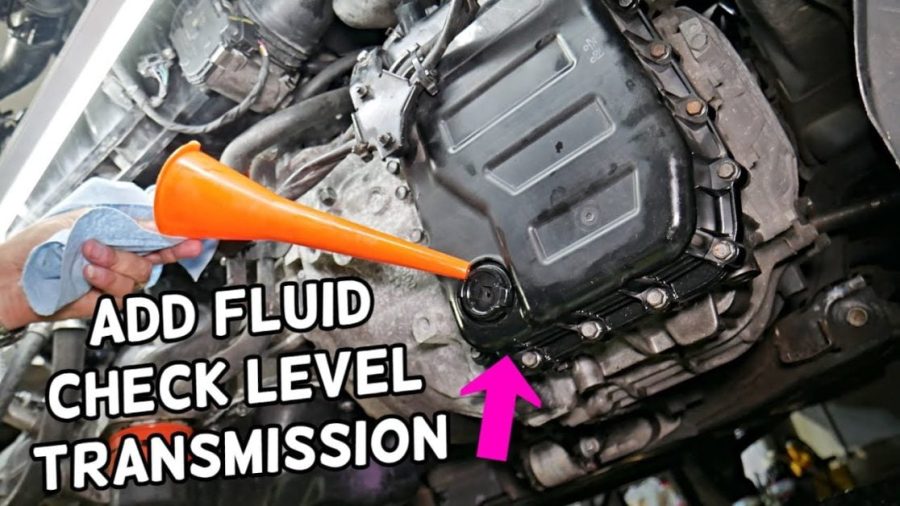
If fluid reads low, add small amounts through the dipstick tube using a long-neck funnel. Pour slowly to prevent overfilling, adding just 1/4 quart at a time. Recheck the level after each addition, allowing 30 seconds for fluid to settle.
Overfilling causes foam formation as the transmission internals churn excess fluid. Foam provides poor lubrication and creates air pockets, leading to erratic shifting and potential damage. If you accidentally overfill, you must drain excess fluid through the transmission pan drain plug.
After adding fluid, drive the vehicle through all gear ranges (Park, Reverse, Neutral, Drive) for 2-3 minutes to circulate new fluid. Recheck the level and add more if needed. This cycling ensures accurate final readings and proper distribution throughout the transmission system.
Common Mistakes & Troubleshooting
Checking fluid when cold produces falsely low readings since transmission fluid expands significantly when heated. Always verify that the engine and transmission have reached operating temperature before checking. Another frequent error is using the incorrect fluid type, which damages CVT belts or automatic clutch packs within 1,000 miles.
Ignoring transmission temperature leads to inaccurate readings. CVT systems are particularly sensitive, requiring fluid temperature between 104-122°F for valid measurements. Without a scan tool, you cannot verify the correct temperature range.
If you notice burning smells or see fluid leaks on your driveway, address them immediately. Transmission fluid leaks commonly occur at pan gaskets, cooler lines, or input shaft seals. Small leaks worsen rapidly, and running low on fluid destroys transmission components within minutes of dry operation.
Error Codes (e.g., P1DD2)
Jeep Compass models may display diagnostic trouble code P1DD2, indicating transmission clutch circuit issues often related to low fluid levels or degraded fluid quality. If this code appears alongside low fluid, refilling may clear the code after driving 50-100 miles. Persistent codes after fluid correction require professional transmission diagnosis.
When to Change Fluid & Professional Help
Complete transmission fluid changes differ from level checks. A full service drains 4-5 quarts and replaces the filter if your model includes one. Jeep recommends transmission fluid replacement every 60,000-80,000 miles for CVT models and 100,000 miles for 9-speed automatics under normal driving conditions.
Severe driving conditions—frequent towing, extreme heat, or stop-and-go traffic—require fluid changes at half these intervals. Professional transmission flush services cost $150-250 at independent shops and $200-350 at dealerships. The higher price includes Mopar-specific fluids and warranty protection.
If you’re uncomfortable performing maintenance or your Compass has a sealed transmission requiring specialized tools, professional service is worthwhile. Dealerships have manufacturer scan tools needed to properly check 9-speed transmission fluid levels and temperatures.
FAQs & Model-Year Tips
Can I check transmission fluid with the engine off?
Most Jeep Compass models require the engine to be running at idle with the transmission in Park. Always consult your owner’s manual for model-specific procedures.
How often should I check transmission fluid?
Check every 30,000 miles or if you notice shifting issues, regardless of mileage. Monthly checks are prudent if you tow regularly or drive in extreme conditions.
Do 2018+ Compass models have dipsticks?
Many 2018-newer Compass models with 9-speed ZF transmissions have sealed systems without dipsticks. These require dealer-level scan tools and specialized procedures for accurate fluid level verification. Attempting DIY checks on sealed transmissions risks improper readings and overfilling.