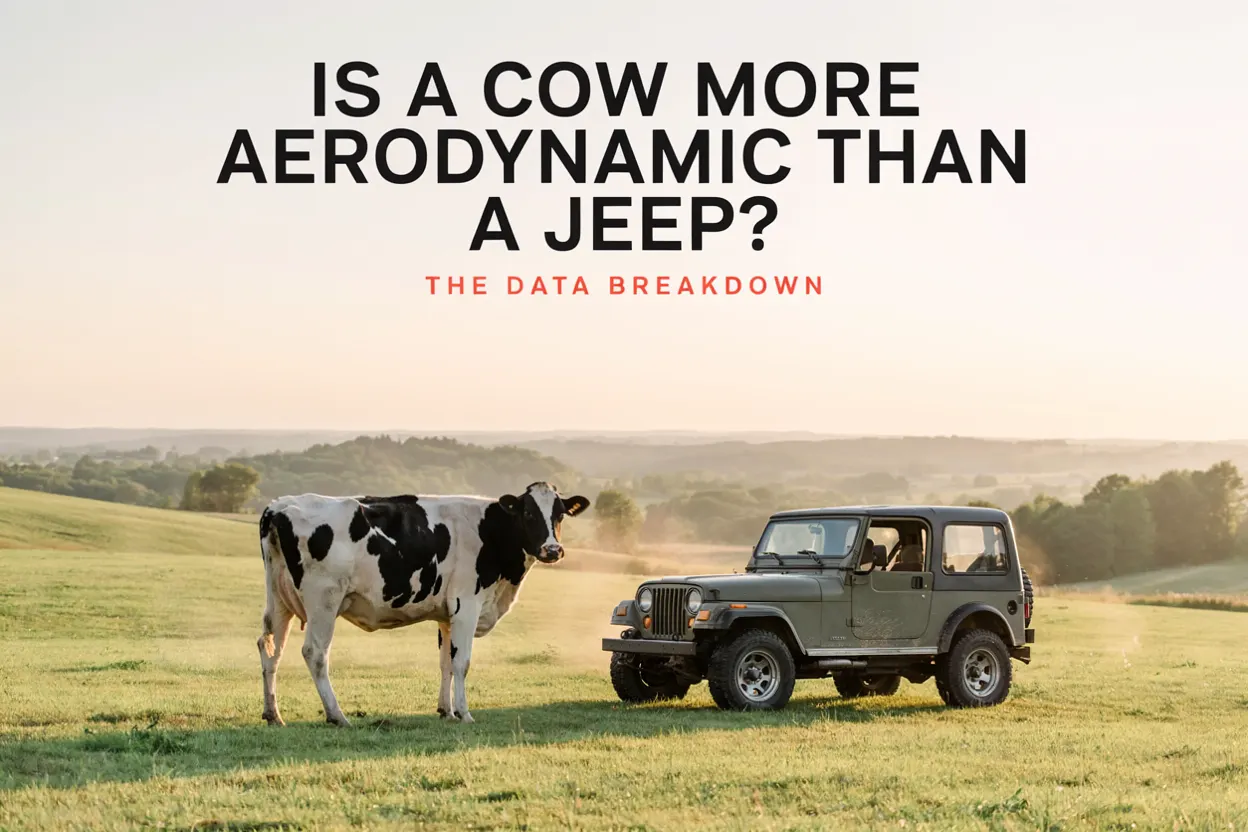
Is a Cow Actually More Aerodynamic Than a Jeep? The Data Breakdown

The Verdict: Who Wins the Drag Race?
Here’s the short answer: it depends on which Jeep you’re comparing.
Against the Jeep Gladiator (drag coefficient of 0.78), a cow wins — and it’s not even close. The cow’s rounded, organic body shape produces a Cd of roughly 0.50–0.65, making it significantly more slippery through air than Jeep’s boxiest truck. That’s the finding behind the original wind tunnel simulation that went viral and confused half the internet.
But compare a cow to the Jeep Wrangler JL (Cd ≈ 0.454), and the result flips. The JL’s modernized front fascia and revised body geometry edge out the mid-range cow simulations. The confusion stems from different sources testing different Jeep models with different cow postures — and nobody clearly labeling which is which.
Shape drives everything. Rounded bodies let air flow around them. Flat ones fight it.
Understanding Drag Coefficient (Cd): The Science Behind the Numbers
Drag coefficient is a dimensionless number that describes how much aerodynamic resistance an object creates as it moves through air. Lower is better. A Cd of 0.23 (Tesla Model 3) means very little resistance. A Cd of 0.78 (Jeep Gladiator) means the vehicle is essentially punching a hole in the atmosphere.
According to NASA’s definition of drag coefficient, the formula accounts for both the object’s shape and its reference area — the frontal cross-section used as a baseline for the calculation. This is where cow-vs-Jeep comparisons get tricky.
A cow and a Jeep have completely different frontal areas. A standing Holstein might present roughly 1.2–1.5 m² of frontal area. A Jeep Gladiator presents closer to 2.8 m². When you calculate the actual drag force, the Jeep creates far more air resistance even if its Cd were identical — because it’s simply bigger. CFD simulations comparing organic geometry to automotive engineering show just how differently air responds to natural curves versus engineered flat panels.
For context, consider this scale:
| Object | Drag Coefficient (Cd) |
|---|---|
| Tesla Model 3 | ~0.23 |
| Modern sedan | ~0.28–0.32 |
| Cow (head down) | ~0.45 |
| Jeep Wrangler JL | ~0.454 |
| Cow (standard) | ~0.50–0.65 |
| Jeep Gladiator | ~0.78 |
Both the cow and the Jeep look terrible next to a Tesla. That’s the real context.
Shape Analysis: Why the Cow’s Body Flows Better
Air doesn’t care about intention. It responds to geometry.
A cow’s body is a study in gradual curves. Air hits the nose, splits smoothly, flows along the rounded flanks, and rejoins cleanly behind the hindquarters. The result is minimal flow separation and a small, compact wake. The cow didn’t evolve for speed — but millions of years of selective pressure created a shape that wastes almost no energy on drag.
A Jeep is the opposite. The flat windshield acts like a wall. Air hits the vertical front face, slams into the sharp A-pillar edges, and tears away in a massive turbulent wake behind the vehicle. That wake is where energy goes to die. Every cubic meter of churning air behind a Jeep Wrangler represents fuel burned for zero forward progress.
The Offroading’s comparison of cow and Jeep shapes illustrates this clearly — the Jeep’s sharp corners create airflow separation almost immediately, while the cow maintains attached flow much further along its body surface.
Adding Jeep Wrangler lift kits raises the body higher, increasing the frontal area and making aerodynamics even worse. Similarly, Jeep Wrangler off-road shocks with lifted suspension geometry push the undercarriage into more turbulent airflow zones, compounding drag at highway speeds.
The cow wins on shape. Full stop. It’s not about intelligence — it’s about curves versus corners.
The Data Battle: Drag Coefficient Numbers Deconstructed
This is where the internet’s confusion lives. Why do some sources say Cow Cd = 0.65 and Jeep Cd = 0.78, while others say Cow Cd = 0.50 and Jeep Cd = 0.454? The answer is simple: they’re testing different vehicles.
MotorBiscuit’s analysis of the drag coefficients focuses on the Jeep Wrangler JL, which Jeep redesigned with a slightly raked windshield and revised front bumper geometry. Jeep measured the JL at 0.454 — genuinely better than a standard-posture cow at 0.50–0.65. That’s a real win for engineering.
The viral video uses the Jeep Gladiator, a pickup-truck variant with a longer bed, boxier cabin, and a Cd of 0.78. The cow simulation at 0.65 beats it handily.
Here’s where it gets more interesting. A cow with its head down — grazing posture — achieves a Cd around 0.45. That’s nearly identical to the Wrangler JL and better than the Gladiator by a massive margin.
What about body modifications? Accessories matter more than most owners realize. Running Jeep Wrangler doors off mirrors without doors exposes raw door frames to airflow, creating turbulence the factory door seals normally manage. Jeep Wrangler fender flares can disrupt airflow along the wheel arch — a small but real Cd penalty.
Looking ahead, the 2026 Jeep Wrangler release date brings speculation about further aerodynamic refinement, though Jeep’s design philosophy has never prioritized drag reduction over trail capability.
The real takeaway? The “cow beats Jeep” headline is accurate for the Gladiator. It’s debatable for the Wrangler JL.
Lift and Stability: The Hidden Aerodynamic Factor
Most articles stop at drag. They’re missing half the story.
Lift coefficient is equally important, and the cow vs. Jeep data here is genuinely striking. At 36 km/h — roughly a cow’s top running speed — a cow generates only 0.4 kg of aerodynamic lift. That’s almost nothing. The rounded body keeps airflow attached evenly on both the dorsal and ventral surfaces, producing near-neutral lift.
A Jeep Wrangler at 72 km/h generates approximately 28 kg of lift. That’s 70 times more lift force than the cow experiences at its natural speed. The flat hood and boxy body act like a crude wing — but the wrong kind. Positive lift reduces tire contact patch pressure, which directly reduces grip.
Why does this matter for drivers? Less grip means longer braking distances and reduced cornering stability. Jeep engineers compensate with suspension tuning and tire compound choices rather than aerodynamic solutions. The cow, by contrast, hugs the ground aerodynamically without any engineering intervention.
This lift data is the part of the comparison that almost nobody discusses. It shows the cow isn’t just “less draggy” — it’s genuinely more stable at speed, on an aerodynamic basis alone. Nature optimized the cow’s shape over millennia without a wind tunnel in sight.
Aerodynamic stability also explains why sports cars run aggressive front splitters and rear wings. They’re solving the same lift problem the Jeep ignores entirely.
Why the Jeep Is Designed This Way: Real-World Trade-offs
Bad aerodynamics aren’t an accident. They’re a choice.
Jeep’s boxy shape exists because it serves a purpose the cow’s body never needed to serve. The vertical windshield maximizes driver sightlines on steep off-road approaches. The flat hood lets drivers see the front bumper from the driver’s seat — critical for rock crawling. The tall, square body provides maximum interior volume relative to exterior footprint.
Jeep Wrangler towing capacity — up to 3,500 lbs on properly equipped JL models — requires a strong, rigid body structure that naturally conflicts with aerodynamic optimization. You can’t have a slippery shape and a body-on-frame truck chassis at the same time.
Jeep Wrangler reliability is built around mechanical simplicity and durability, not efficiency. The drivetrain, suspension geometry, and ground clearance all take priority over wind resistance in Jeep’s engineering hierarchy.
Add Jeep Wrangler rock rails for body protection and you’ve added more blunt edges catching wind. These trade-offs are deliberate. Off-road durability and aerodynamic efficiency pull in opposite directions.
The cow evolved for grazing, thermoregulation, and predator evasion. The Jeep was engineered for mud, rocks, and towing. Neither shape is “wrong” — they’re optimized for completely different missions.
FAQ: Common Questions About Cow and Jeep Aerodynamics
Is a cow scientifically proven to be more aerodynamic than a Jeep?
Yes — against the Jeep Gladiator (Cd 0.78), a standard cow (Cd 0.50–0.65) is more aerodynamic in CFD simulations. Against the Jeep Wrangler JL (Cd 0.454), the comparison is much closer, and the JL may actually win depending on the cow’s posture in the simulation.
What is the most aerodynamic Jeep ever made?
The Wrangler JL is Jeep’s slipperiest production Wrangler, with a Cd of approximately 0.454. That’s still dramatically worse than any modern passenger car, but it represents meaningful progress over older Wrangler generations.
Does removing Jeep doors make it less aerodynamic?
Yes, significantly. The door seals and panels manage airflow along the vehicle’s sides. Learning how to take Jeep Wrangler doors off is popular for open-air driving, but it creates new turbulence along the B-pillar and rocker panel area, increasing drag.
Does a cow’s posture affect its drag coefficient?
Absolutely. A head-down grazing cow achieves roughly Cd 0.45, nearly matching the Wrangler JL. A standing cow with head raised measures closer to 0.65. Posture matters in aerodynamics — for cows and cars alike.
Can you make a Jeep as aerodynamic as a cow?
Not while keeping it a functional off-road vehicle. Rounding the corners, sloping the windshield, and adding a tonneau cover all reduce drag incrementally. But the fundamental shape requirements of a trail-capable 4×4 prevent getting anywhere near a cow’s natural Cd.
Final Verdict: Nature vs. Utility
The cow wins the aerodynamics battle — mostly.
Against the Gladiator, it’s a decisive cow victory. Against the Wrangler JL, the result is a genuine toss-up that depends on which cow simulation you’re referencing. What’s not in dispute: the cow’s rounded body is a masterclass in airflow management, producing minimal drag and near-zero lift through pure geometric efficiency.
The Jeep, meanwhile, isn’t trying to be aerodynamic. It’s trying to be unbreakable, capable, and useful — goals that require exactly the kind of boxy, angular shape that aerodynamics punishes. Jeep Wrangler reliability and trail performance justify every aerodynamic compromise built into that shape.
Investing in a best Jeep Wrangler oil filter matters far more to Wrangler ownership than worrying about drag coefficients. And the upcoming Jeep Wrangler hybrid signals Jeep is finally looking at efficiency — though through electrification, not aerodynamic redesign.
The cow is a master of flow. The Jeep is a master of the trail. Neither would survive doing the other’s job.