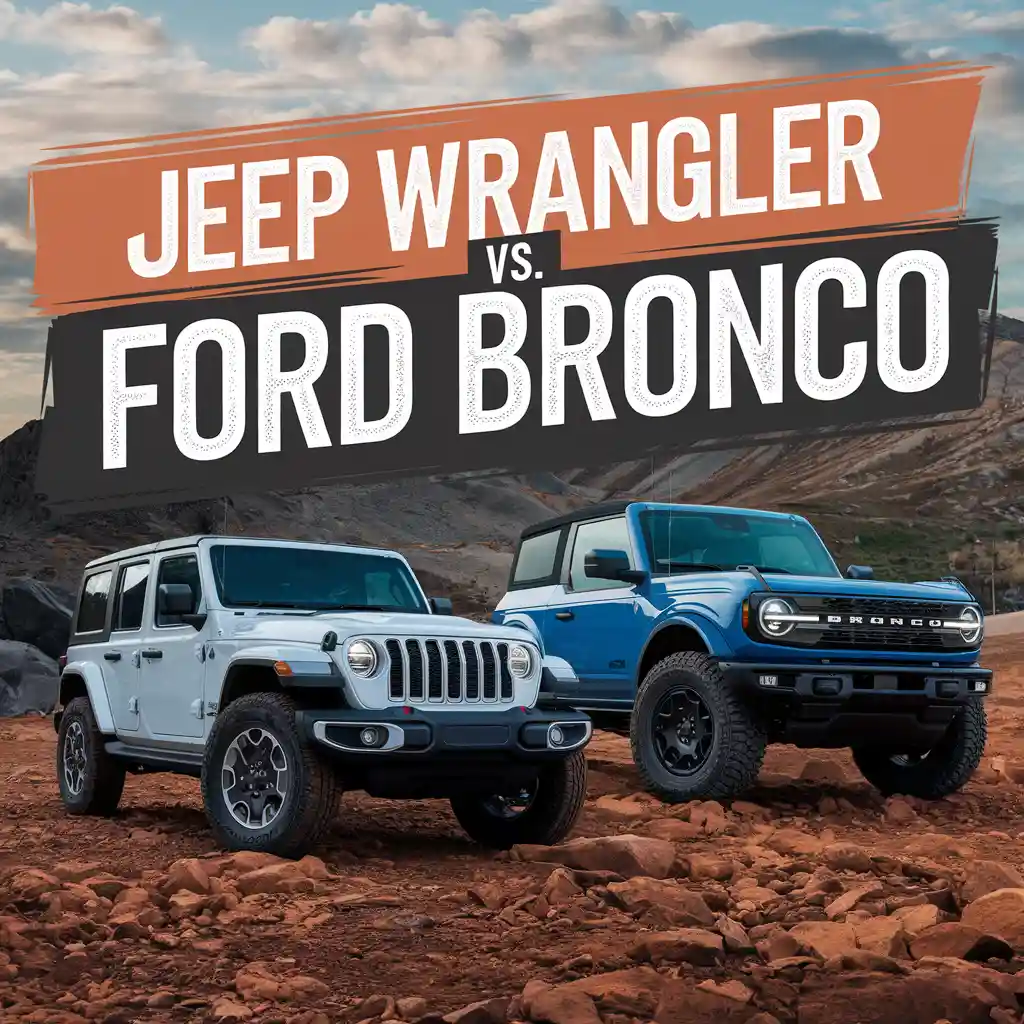
Jeep Wrangler vs. Ford Bronco (2026): Ultimate Off-Road SUV Comparison

Quick Verdict: Who Should Choose Which?
The Bronco wins for buyers who split time between highways and trails. It rides smoother, packs more passenger space, and earns a 5-star NHTSA safety rating. The Wrangler wins for serious off-road enthusiasts who prioritize rock crawling, a wider mod ecosystem, and the legendary solid axle setup that’s dominated trails for decades. If your weekdays involve highway commuting and your weekends involve forest roads, choose the Bronco. If you’re pointing at boulder fields and technical terrain, the Wrangler Rubicon is your answer.
Engine, Power & Performance Breakdown
Both trucks offer serious power. The real question is what kind of performance you actually need.
The Ford Bronco starts with a 2.3L EcoBoost four-cylinder making 300 hp and 325 lb-ft of torque. Step up to the 2.7L twin-turbo V6 and you get 330 hp with 415 lb-ft. At the top, the Bronco Raptor’s 3.0L twin-turbo V6 delivers a brutal 418 hp. Transmission options include a 10-speed automatic or a rare 7-speed manual.
The Jeep Wrangler offers its 3.6L Pentastar V6 as the base engine, producing 285 hp and 260 lb-ft. The 2.0L turbocharged four-cylinder makes 270 hp but a competitive 295 lb-ft. Then there’s the Wrangler 392 — a 6.4L HEMI V8 that punches out 470 hp and 470 lb-ft of torque. That’s a serious number. Wrangler transmissions are an 8-speed automatic or 6-speed manual.
Off the line, the Wrangler 2.0L Turbo surprises most people. Car and Driver’s 2021 Bronco vs. Wrangler acceleration test clocked the 2.0T hitting 60 mph in 5.8 seconds — quicker than most buyers expect from a boxy off-roader. The Bronco’s 2.3L is no slouch, but the Wrangler turbocharged four-cylinder holds its own on ramps and passing lanes.
The Bronco’s 10-speed automatic gives it a clear gearing advantage for on-road smoothness. The Wrangler’s 3.6L V6 pairs better with the 8-speed, particularly for towing and moderate trail work. For peak power in either lineup, the Wrangler 392 HEMI is unmatched — but it’s a specialty trim with a premium price. Thinking about maximising the Wrangler’s 2.0T? Check out the best oil for Jeep Wrangler 2.0 Turbo to protect that engine on longer runs.
Off-Road Capability: Suspension, Clearance & 4×4 Systems
This is where the two trucks diverge most sharply.
The Ford Bronco uses an independent front suspension (IFS), which allows each wheel to move independently. That means less body roll on roads, better high-speed stability, and a smoother ride on dirt tracks. The Wrangler runs a solid front axle, where both wheels stay connected. Watch the 2024 Jeep Wrangler vs. Ford Bronco off-road comparison video to see this difference play out in real trail conditions.
Solid Axle vs. IFS: Why It Matters for Off-Roaders
On technical terrain — think rocky ledges, uneven boulder fields, extreme articulation challenges — the solid axle wins. Here’s why.
When one wheel drops into a hole, the solid axle keeps both wheels in better contact with the ground. That’s called axle articulation. More articulation means more traction when surfaces get unpredictable. IFS limits articulation by design. The Bronco compensates with strong Bilstein shocks and tuned geometry, but the physics still favor Jeep on the gnarliest terrain.
Ground clearance splits interestingly across trims. The Bronco Raptor clears 13.1 inches. The Wrangler Moab 392 manages 11.1 inches. That Raptor number is genuinely impressive. However, the Wrangler Rubicon’s portal axles and 4.88 gear ratios give it technical advantages the raw ground clearance number doesn’t fully capture.
The Bronco runs 7 G.O.A.T. (Goes Over Any Type of Terrain) drive modes. These cover Normal, Eco, Sport, Slippery, Sand, Baja, and Rock Crawl. The Wrangler offers multiple 4WD configurations depending on trim, including a full-time 4WD option and the Rubicon’s electronic sway bar disconnect — a genuine trail capability advantage.
For most buyers doing moderate off-roading, both vehicles perform exceptionally well. For rock crawling, the Wrangler’s solid axle setup and wider range of best lift kit for a Jeep Wrangler options give it a real edge in the modification ecosystem.
Interior, Tech & On-Road Comfort
Daily driving comfort matters just as much as trail performance for most buyers.
The Bronco 4-door offers 108.2 cubic feet of passenger volume against the Wrangler 4-door’s 103.7 cubic feet. That’s a meaningful difference on longer trips. Cargo space flips the script — the Wrangler 4-door delivers 31.7 cubic feet behind the rear seats versus just 22.4 cubic feet in the 2-door Bronco. If you’re hauling gear for multi-day camping trips, check out the best Jeep Wrangler cargo racks to maximize the Wrangler’s usable space.
The Bronco ships with a 12-inch SYNC 4 touchscreen as standard equipment. Wrangler tech varies by trim — base Sport models get a smaller screen, with the larger Uconnect 5 display reserved for higher trims. This matters if you want wireless Apple CarPlay and Android Auto without paying for an upgrade.
On-road ride quality clearly favors the Bronco. The IFS absorbs road imperfections without transmitting the choppiness that Wrangler owners sometimes report on rough pavement. Less body roll, better high-speed stability, and quieter cabin noise make the Bronco genuinely pleasant for daily commuting. The Wrangler’s ride is acceptable — just don’t expect it to feel like a crossover SUV.
Safety is a real differentiator. The Bronco holds a 5-star NHTSA overall safety rating. The Wrangler has not received a comparable NHTSA rating. For buyers with families in the vehicle regularly, that gap is worth serious consideration. The Ford dealer’s Bronco vs. Jeep safety and tech breakdown outlines the Bronco’s full active safety suite, which includes pre-collision assist, blind-spot monitoring, and lane-keeping as standard on most trims.
Both vehicles offer removable doors, a feature that’s become a signature for open-air driving enthusiasts. If you own a Wrangler, learning how to take Jeep Wrangler doors off safely is a skill worth having from day one. When doors come off, you’ll also want a pair of best Jeep Wrangler doors-off mirrors for legal compliance and visibility.
Price, Towing & Value Comparison
The price gap at entry is significant. The 2025 Wrangler Sport starts around $34,090 MSRP. The Bronco base trim opens at approximately $40,990 — a $6,900 premium from the start. Both vehicles climb steeply toward premium trims. The Bronco Raptor and Wrangler Rubicon 392 both push into the $77,000–$100,000 range when fully loaded.
Towing capacity breaks differently by configuration. The Bronco Raptor pulls 4,500 lbs. The standard 2-door Bronco manages 3,500 lbs. The Wrangler 4-door handles up to 3,500 lbs, while the 2-door Wrangler is limited to 2,000 lbs. For a deeper look at towing by specific Wrangler trim and year, the Jeep Wrangler towing capacity guide breaks down every configuration. If maximum towing is your priority, the Bronco Raptor’s 4,500-lb rating leads the comparison outright.
Fuel economy goes to the Wrangler, slightly. The Wrangler returns approximately 17 mpg city and 23 mpg highway. The Bronco averages 18 mpg city and 21 mpg highway. The Wrangler’s highway advantage matters on long road trips. See TrueCar’s fuel economy comparison: Wrangler vs. Bronco for current EPA-estimated figures across trims.
Both vehicles carry identical warranty terms — 3 years / 36,000 miles basic coverage and 5 years / 60,000 miles powertrain. Refer to Kelley Blue Book’s 2025 Jeep Wrangler vs. Ford Bronco comparison for current MSRP ranges, dealer pricing data, and resale value projections across trims.
Specs Comparison Table
| Feature | Ford Bronco | Jeep Wrangler |
|---|---|---|
| Base Engine | 2.3L EcoBoost 4-cyl (300 hp) | 3.6L Pentastar V6 (285 hp) |
| Top Engine | 3.0L twin-turbo V6 (418 hp) | 6.4L HEMI V8 (470 hp) |
| Transmission | 10-speed auto / 7-speed manual | 8-speed auto / 6-speed manual |
| Suspension | Independent front (IFS) | Solid front axle |
| Max Ground Clearance | 13.1 in (Raptor) | 11.1 in (Moab 392) |
| Passenger Volume (4-dr) | 108.2 cu ft | 103.7 cu ft |
| Max Towing | 4,500 lbs (Raptor) | 3,500 lbs (4-door) |
| Fuel Economy (hwy) | 21 mpg | 23 mpg |
| NHTSA Safety Rating | 5-star | Not rated |
| Base MSRP (2025) | ~$40,990 | ~$34,090 |
| Drive Modes | 7 G.O.A.T. modes | Multiple 4WD configs |
| Warranty | 3yr/36k + 5yr/60k | 3yr/36k + 5yr/60k |
Who Should Choose the Ford Bronco?
Choose the Bronco if daily driving comfort is non-negotiable. Its IFS, quieter cabin, 5-star safety rating, and standard 12-inch touchscreen make it a better all-around daily driver. The 4,500-lb Raptor towing rating suits buyers who pull small trailers or boats on weekends. Families benefit most here. New off-roaders who want capability without constant compromise will find the Bronco far easier to live with every day.
Who Should Choose the Jeep Wrangler?
Choose the Wrangler if trails are your primary focus. The solid axle, broader 4WD options, and decades of aftermarket support give it an unmatched ecosystem for serious builds. The Rubicon 392 is genuinely extraordinary on technical terrain. Wrangler owners also benefit from one of the largest mod communities in automotive culture — covering everything from best Jeep Wrangler shocks to best all-terrain tires for Jeep Wrangler setups. Curious about what’s coming next? The 2026 Jeep Wrangler release date page covers the latest updates on specs and trim changes.
FAQ: Bronco vs. Wrangler Key Questions
Which has better off-road capability?
For technical trails and rock crawling, the Wrangler wins. Its solid front axle delivers superior articulation on uneven surfaces. The Bronco handles moderate off-road terrain brilliantly and outperforms the Wrangler at higher off-road speeds thanks to its IFS and Bilstein shock tuning.
Is the Bronco more comfortable on pavement?
Yes. Significantly. The IFS reduces road chop, limits body roll, and contributes to a quieter highway experience.
Which is cheaper?
The Wrangler’s base price is roughly $6,900 less than the Bronco’s starting trim. Both reach similar price points at high-end configurations.
Can you remove doors on both?
Yes. Both vehicles offer removable doors as a standard feature. It’s one of the signature open-air experiences both brands share.
Which has better fuel economy?
The Wrangler edges ahead on highway driving at 23 mpg vs. 21 mpg for the Bronco. City driving is similar.
Is the Wrangler reliable?
It’s a valid concern for many buyers. Check out this detailed breakdown on whether Jeep Wranglers are reliable before committing.
Final Verdict
The Ford Bronco and Jeep Wrangler are both exceptional trucks — just optimized for different buyers. The Bronco delivers more comfort, better safety scores, and a stronger towing rating in its top trim.
The Wrangler counters with deeper off-road credibility, a V8 option, better highway fuel economy, and a mod ecosystem with no equal. Neither vehicle is objectively better. The right choice depends entirely on how you use it.
Mostly commuting with weekend trail trips? Buy the Bronco. Living on rocks, planning big lifts, and chasing technical terrain? The Wrangler is your truck.