Tesla Model S Years to Avoid: The Worst Model Years Explained

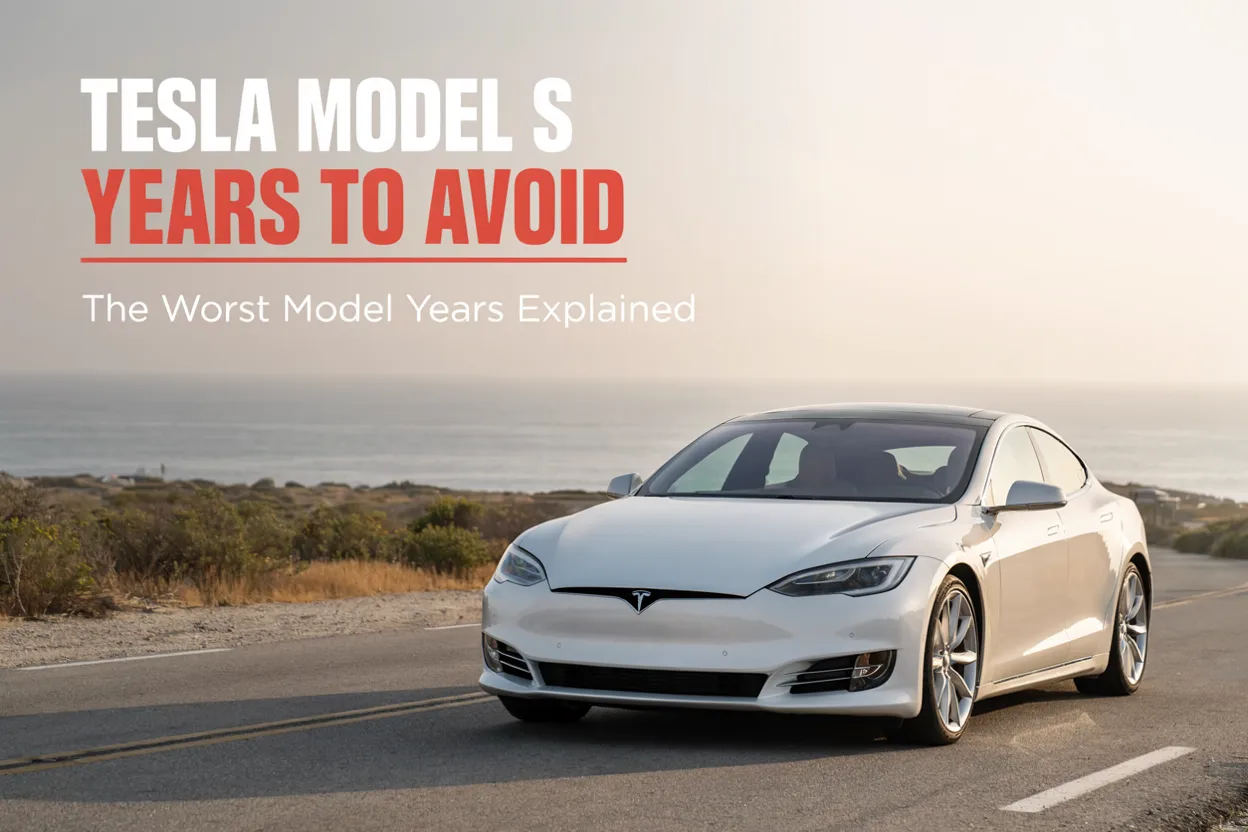
Buying a used Tesla Model S can be a brilliant move — or a very expensive mistake. The Model S has been on sale since 2012, and Tesla changed its hardware, software, and manufacturing processes repeatedly over that time. That makes model year selection critical for used buyers.
Some years carry far more risk than others. This guide cuts through the noise and gives you a clear, evidence-based list of which Tesla Model S years to avoid, what goes wrong in each, and which years are safer bets.
Quick Answer: Tesla Model S Years to Avoid
If you’re short on time, here’s the core answer.
Avoid these years: 2013, 2014, 2015, 2016, 2017, and 2021. The 2012 launch year also carries early-adopter risk, though fewer examples remain in private sales.
The 2013–2017 block consistently draws the highest NHTSA complaint volumes and appears in nearly every used-EV reliability warning list. The 2021 Model S stands out separately — it earned poor reliability scores in some datasets despite being a much newer car, largely due to a high recall burden.
One important caveat. Model year alone doesn’t tell the full story. A well-maintained 2016 with fresh service records can outperform a neglected 2019. Always check the specific car, not just the badge year.
| Year | Risk Level | Main Issues |
|---|---|---|
| 2012 | High | First-year bugs, limited service history |
| 2013 | High | Electrical faults, battery cooling |
| 2014 | High | MCU glitches, fit issues |
| 2015 | Very High | Suspension, door handles, MCU |
| 2016 | Very High | Most complaint-heavy year |
| 2017 | High | Autopilot hardware issues |
| 2021 | High | Recalls, reliability drop |
| 2018–2020 | Lower risk | More mature hardware |
| 2022–2025 | Lowest risk | Refreshed platform |
1. Tesla Model S Years to Avoid: 2012–2014
These are the riskiest years on the used market. Full stop.
The 2012 Model S was a genuinely revolutionary car, but it was also Tesla’s first mass-market product. Early build quality reflected that. Panel gaps, rattles, and creaking interiors were common owner complaints, and the company was still learning how to scale production.
Key Failure Areas
- Battery thermal management — early cooling systems were less refined, raising long-term degradation risk
- Electronic door handles — the motorized pop-out handles began failing at high rates from the start
- Touchscreen and MCU — the original Media Control Unit used an 8GB Tegra chip that degraded over time
- Charging system issues — early high-power wall connectors caused connector failures and even scorching
The 2013 Model S saw some refinements but inherited most of the same underlying problems. NHTSA received significant electrical system complaints for this year, with owners reporting unexpected warning lights, power loss, and charging failures. The 2014 improved again but still pre-dated the major hardware revisions that came later.
These cars are cheap for a reason. A 2013 Model S priced at $20,000 might look like a bargain, but a battery replacement alone can cost $15,000–$20,000 or more depending on the pack configuration.
Our Verdict
Only consider a 2012–2014 Model S if it has a full documented service history, recent battery health records, and a price that reflects the risk. Most buyers should skip this block entirely.
2. Tesla Model S Years to Avoid: 2015–2017
This three-year block is the most complaint-heavy period in Model S history.
The NHTSA complaint and recall database shows the 2015 and 2016 Model S generating some of the highest owner complaint volumes of any Model S year. The 2017 is only marginally better.
2015 Model S Problems
The 2015 Model S introduced Autopilot hardware, which was exciting — but it also brought new software instability. Suspension failures became a serious problem this year. Several owners reported unexpected changes in suspension characteristics after service, and the issue attracted significant media and regulatory attention.
Electronic door handles remained a persistent complaint. The motorized mechanism failed frequently, sometimes trapping occupants or refusing to release. Door handle replacement costs ranged from several hundred to over a thousand dollars per handle.
2016 Model S Problems
The 2016 year is arguably the single worst Model S vintage to buy used.
NHTSA received hundreds of complaints for the 2016 Model S, covering electrical system failures, suspension concerns, and powertrain issues. The MCU continued to degrade. Some owners reported complete touchscreen failure, which in the Model S affects climate control, navigation, charging management, and nearly every vehicle function.
Fit-and-finish problems peaked around this period. Owners reported gaps in body panels, wind noise at highway speeds, and trim pieces detaching.
2017 Model S Problems
The 2017 improved slightly on its predecessors but still draws significant complaints. Autopilot hardware limitations were a known issue — cars built before October 2016 shipped with AP1 hardware, which Tesla later described as unable to support full self-driving even with software updates.
Battery degradation in 2017 cars is now more measurable, with many examples showing meaningful range loss from their original EPA ratings. Always verify real-world range against the EPA figure before buying.
Our Verdict
Avoid all three years unless pricing is deeply discounted, documentation is exceptional, and you budget for repairs. A pre-purchase inspection from a third-party EV specialist is non-negotiable for any 2015–2017 example.
3. Why Some Sources Flag the 2021 Tesla Model S
Here’s where the data gets interesting — and sometimes confusing.
Most “years to avoid” lists focus on early Model S production. But some reliability datasets single out the 2021 Model S specifically, which surprises buyers expecting newer to mean safer.
The 2021 Model S received a significant redesign. Tesla updated the interior with a new yoke steering option, a revised infotainment system, and a new three-screen cabin layout. New tech in its first year. That’s a pattern that often produces reliability issues.
Consumer Reports reliability data assigned the 2021 Model S a below-average predicted reliability score, driven by owner-reported problems across multiple systems. New electronic components, revised HVAC architecture, and updated software all contributed to a rocky first year for the refreshed platform.
The 2021 also carried a notable recall burden. NHTSA issued multiple recalls covering forward collision avoidance system software, touchscreen failures, and lighting system compliance issues. Recalls don’t make a car unfixable, but a high volume of first-year recall notices signals a platform that wasn’t fully sorted at launch.
Understanding Does Tesla Car Have Autopilot? matters here too. The 2021 model shipped with updated Autopilot hardware, but early software implementations had known forward-collision warning quirks that generated NHTSA complaints.
Our Verdict
The 2021 is not as risky as a 2016, but it’s riskier than a 2019. If you’re considering a 2021, verify all recalls have been completed via VIN lookup before committing.
4. Common Tesla Model S Problems Behind the Bad Years
These are the recurring failure patterns that show up across the worst Model S years. Knowing them helps you inspect any used example intelligently.
Understanding ongoing ownership costs is part of the picture too. Do Teslas need maintenance? — the answer is yes, just differently than ICE cars. And knowing how many miles a Tesla battery can last helps you evaluate whether a used example is still mid-life or near a costly replacement.
It’s also worth understanding how does Tesla heat the cabin — HVAC issues, especially in cold climates, appear in Model S complaint data more than many buyers expect.
Electrical System Issues
Electrical failures are the single most-reported problem category in Model S NHTSA complaints. Symptoms range from warning lights and unexpected shutdowns to complete loss of power while driving. Early cars used less mature high-voltage architecture, and water intrusion into electrical components drove multiple complaints in 2013–2016 examples.
Suspension Problems
Suspension failures attracted regulatory scrutiny around 2016. The issue wasn’t just ride quality — some owners reported sudden changes in vehicle handling characteristics. A pre-purchase inspection should always include a professional suspension evaluation.
Touchscreen and MCU Failures
The original MCU used in 2012–2018 Model S cars contained an 8GB eMMC flash chip. That chip degrades over time with normal use. When it fails, the touchscreen dies — and with it, nearly every major vehicle function.
Tesla issued a recall (NHTSA recall 20V-219) covering some Model S and X vehicles with MCU degradation. However, many owners outside the recall window still experienced failures. MCU replacement costs around $1,500–$3,000 if not covered.
Battery Degradation Concerns
Tesla batteries lose capacity over time. Most owners report 10–15% degradation after 100,000 miles under normal conditions. But poorly maintained early cars — especially those charged frequently to 100% or left at low state of charge — can show far more degradation.
Door Handle Failures
This is almost universal in early Model S ownership discussion. The motorized pop-out handles are a design liability. High failure rates, high replacement costs, and an ongoing annoyance even after repair.
5. Best Tesla Model S Years to Buy Instead
You’re not locked out of the used Model S market. Several years offer genuinely better reliability odds.
2018 and 2019 are the most commonly recommended years for used buyers. The 2018 benefited from several years of platform maturity while pre-dating the MCU2 transition teething troubles. The 2019 is often described as the sweet spot — mature hardware, Autopilot Hardware 3 in later builds, and cleaner build quality than earlier cars.
2022 and newer represent the post-refresh platform, with the redesigned cabin, improved battery chemistry, and more sorted software. These cost more but carry less used-car risk from a reliability standpoint.
Understanding Do Teslas depreciate quickly is critical here. Tesla prices dropped significantly across 2022–2024, which means a 2022 or 2023 certified example can now fall within reach of buyers who were previously looking at 2017–2019 pricing. That’s a meaningful shift in the value calculation.
For a deeper look at model-year differences, the Tesla Model S buying guide on CarGurus breaks down trim and option changes clearly. You can also review the best Tesla Model S years to buy used on AutoTrader for independent editorial guidance.
Does Tesla require maintenance? on newer years is still yes — tires, brakes, cabin air filters, and battery care all matter. But later-year cars generally carry lower near-term repair risk.
6. How to Check a Used Tesla Model S Before Buying
Don’t rely on year alone. Always verify the specific car.
What to Inspect in Person
- Touchscreen function — tap every menu, check responsiveness, and look for lag or blank patches
- Door handles — cycle all four handles multiple times; any hesitation signals a failing mechanism
- Panel gaps and body alignment — uneven gaps on a Tesla often indicate poor assembly or a prior collision repair
- Suspension feel — drive over speed bumps and listen for clunks or rubbing
- Climate control — run heat and AC at full power, especially in cars pre-dating the heat pump (pre-2021)
Thinking about total ownership cost matters. Before buying, ask yourself how much does it cost to charge a Tesla? and how many kWh does it take to charge a Tesla? — running costs are low, but you need to budget correctly. You might also wonder can you charge a Tesla in the rain? — the answer is yes, safely, but it’s a common question worth understanding before ownership.
Knowing how long you can expect your Tesla to last helps frame whether the asking price represents good value at the current mileage.
What to Ask the Seller
- Full service history, including any Tesla mobile service records
- Battery health report from the Tesla app (ask to see it in person)
- Any out-of-warranty repair invoices
- Confirmation that all NHTSA recalls have been completed
Use the check Tesla Model S recalls by model year tool on NHTSA’s site to look up the specific VIN before you buy.
When to Walk Away
Walk away if:
- The seller refuses to provide battery health data
- The touchscreen shows lag, blank areas, or slow response
- Any door handle fails to deploy on the first try
- There’s no service history beyond the original purchase
- Multiple open recalls haven’t been completed
7. FAQ About Tesla Model S Years to Avoid
What is the worst Tesla Model S year?
The 2016 Model S generates the highest owner complaint volumes in NHTSA data and appears most frequently in reliability warning lists. The 2015 is a close second. If forced to name a single year to avoid, 2016 is it.
Are early Model S cars reliable?
Early Model S cars (2012–2014) have significant risk, especially around battery health, electrical systems, and door handles. They can work well with excellent maintenance history, but the risk profile is meaningfully higher than later years.
Is a 2021 Model S a bad buy?
Not necessarily — but it’s riskier than a 2019 or 2022. The 2021 was the first year of a major refresh, and first-year reliability scores reflect that. Verify all recalls are resolved before buying.
Which Model S years are safest used?
The 2018, 2019, 2022, and 2023 Model S are generally the safest used purchases based on complaint data and reliability scoring. The 2019 is often cited as the best balance of mature hardware and reasonable used pricing.
Do older Model S cars still get software updates?
Yes, but with limitations. Tesla’s over-the-air updates continue for most in-service Model S cars, but some features — including certain Autopilot enhancements — require hardware versions that older cars don’t have.
The Bottom Line
The Tesla Model S is a remarkable car in the right model year. It’s a financial risk in the wrong one.
Avoid 2013–2017 unless the price, documentation, and inspection results are all exceptional. Treat the 2021 with caution despite its newer age. Focus your search on 2018–2019 and 2022–2025 examples for the best combination of platform maturity and long-term reliability.
Always inspect the specific car. Always check NHTSA recalls by VIN. Always get battery health data before signing anything.
A great used Model S exists. Finding it just requires knowing which years to skip first.